Friday, January 28, 2011

Yum yum, Give Me Some

The Godfather, whom I've taken to referring to in real life as Commander Killjoy, has now become a loyal reader of this blog. He promptly informed me that the blog is worthless, as it barely focuses on him at all and certainly fails to document the vast universe of witty nuggets that pass his lips on any given day. He's made it clear that he expects this situation to be rectified, chop chop.

This directive came on the heels of a conversation in which he laid out his plan to use our recently-ordered simultaneous interpretation equipment to beam his inner monologue directly into the ears of his minions. I pointed out the logistics difficulties -- interpreter's equipment has only a short range -- and he decided on the spot (rapid, decisive leadership) to move all 92 members of the PRT into the Senior Enlisted office next to his. "But you'll only have 10 earpieces," I said.

"The best part of this plan," he replied, "is that you will only have an earpiece, and not a mouthpiece."

(The simultaneous interpretation equipment is a mic with 10 wireless earpieces for it, which will allow our interpreters, who do whispered translation during shuras, to be heard by everyone who has an earpiece and not just by those in their immediate vicinity; I told the Godfather that I'd ordered us a force multiplier from the Embassy and he promptly responded -- "You ordered another Commander Killjoy? Because that's really the ultimate force multiplier.")

I can only assume he's still mad at me for naming a to-be-slaughtered goat after him.

Christmas: there's an unexpected Kenyan-American on the SecFor team -- Specialist Masai -- and he, born and raised in East Africa, had been itching to get his hands on a celebratory goat. I had dropped a few not-so-subtle Yule-season hints to the Governor that being gifted a Christmas goat would be much appreciated, but it never came to fruition; rather than relying on the kindness of others, SecFor took up a collection of a couple bucks a man, and one of our interpreters called a guy he knows, and two hours and 90 bucks later a goat showed up at the front gate.

(There's a goat market just down the street from the FOB -- goat is the preferred red meat in the Afghan diet -- and said goat market is rumored to sell poppy and raw opium paste on certain days of the week; I have never seen the market and can neither confirm nor deny these rumors).

The goat was tied it up in a concrete bunker just behind the operations center and left it a bowl of water and a plate of goat-inappropriate food that SecFor generally appreciates -- turkey bacon and corn dog chunks, things on that order. The water bowl was Styrofoam and the goat hoofed through two of them before Masai took over, leaving the water at a distance where the goat could drink it without kicking it over, and supplying a tray of lettuce. "What are you naming it?" I asked the guys. "Oh, we're not naming it," I was told. "We don't want to get too attached."

I deemed that to be unacceptable. I named him after myself: Little Dakota.

I was worried that Little Dakota wouldn't provide enough meat for the entire PRT, so I checked with Captain Adventure (the tall and self-assured head of SecFor, who specifically asked for his nickname; I was going to call him Mortarshoot -- he's an infantryman at heart -- but Adventure seems equally apropos) to see if I could sponsor another goat. He greenlighted it. "If there's anything these guys could use," he said, "it's more killing." I ponied up the 90 bucks.

Little Dakota was small and black and gentle, and got along with everyone and generally abhorred violence in the form of headbutting, and when the second goat arrived it was clear that he was everything Little Dakota was not: wild-eyed and bucking, with a swagger in his step and larger, more threatening horns. Little Dakota was a peace-maker; the new goat was tougher, a warrior with no interest in diplomacy or making friends. The metaphor was too perfect; I named him Little Godfather.

Portrait in Sepia: Little Godfather in the foreground; Little Dakota in the Background

"I'm gonna be out there and make sure he puts up a god damn FIGHT when it's his time to go," the Godfather said. He didn't need to oversee the process, though: Little Godfather was out for blood, and would headbutt any SecFor guy who got too close.

I spent the morning of the slaughter feeding the goats animal crackers ("wrap your mind around how meta THIS is, guys") and generally trying to ensure that their last hours were pleasant. There was a brief discussion about where the slaughter should actually take place; we toyed briefly with the idea of doing it on the concrete slab formerly used for basketball but from which all the hoops had been removed by Sergeant Major MoraleKill, the senior enlisted man of the Maneuver unit, who had de-hooped the court as a means of preventing injuries. They ultimately decided to keep the slaughter on PRT turf, near the concrete bunker where the goats had spent the night.

There had been a spirited debate about who would actually do the goat slaughtering -- Sergeant DoubleD (who holds some sort of NCO position within the SecFor, though what he's actually tasked with is beyond me; the name DoubleD -- that's Domestic Dispute -- is taken from the ongoing and protracted arguments, punctuated with equal numbers of "baby I love you and miss you," that he has with his wife in the public arena of Facebook. "Facebook is nothing," I was told. "You should hear them argue on the phone.") wanted in on the action, but it was decided that Masai, who had long experience in all things goat, should actually be in charge of the first one.

Little Godfather was the first to go.

Just before the slaughter: Specialist Masai, assisted by Sergeant DoubleD

Masai took him by the horns (DoubleD had tried to pet him and had gotten headbutted, and kept a berth from that point forward), dragged him to the appointed area, and held him down with his neck over a fifty-cal ammo can -- a metal box used to hold bullets. Little Godfather bleated mournfully -- not an "I'm in pain" bleat or even an "I'm scared" bleat, but more of a "Wow, this is a shitty situation and I am helpless against it" sort of bleat that I found oddly depressing. The scene had drawn a crowd of cameramen; I walked away for the actual cutting.

A gaggle of bloodthirsty PRT-types; Captain Adventure is kneeling, second from right

Masai gutted and skinned the goats (Afghans usually skin the goats by attaching an air hose to them, in essence inflating the skin off the carcass; Kenyans, it seems, just use a balled fist to work the skin off the meat), and then they were wrapped in tin foil, buried in a pit just outside the FOB gate, and covered in hot coals and a thick layer of moon dust.

We dug them up six hours later. "I hate to be all food-safety civilian here," I said, "but maybe we should consider stabbing them with a meat thermometer to make sure they've reached an internal temperature of at least 160 degrees?" "You know, that's a good idea," Captain Adventure said. "Does anyone here have their meat thermometer on them? Sergeant DoubleD? Specialist Masai? Anyone? No?" He looked at me like I was an idiot, grinned, and started digging. The goats smelled delicious.

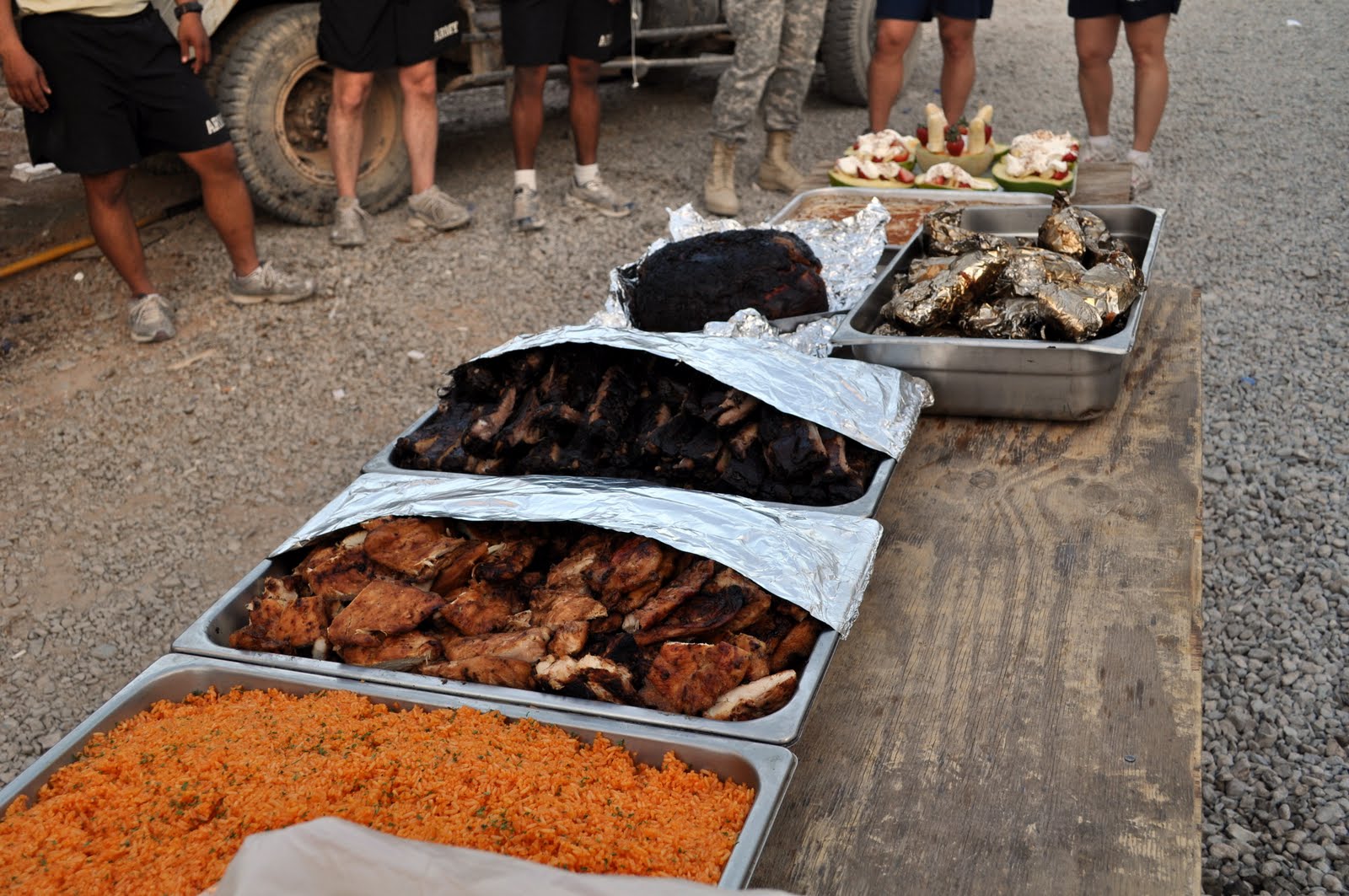
Little Dakota and Little Godfather were served alongside Carne Asada and an enormous pot of rice that the Governor's staff made for us. (In addition to the pot of rice, the Governor sent over four additional goats the next day; they were put into Dynecorp's FOB petting zoo along with a cow, a turkey, and multiple other goats). The final verdict on our goats was that they should have been dug up an hour earlier -- they were definitely over-roasted -- but Masai declared them delicious and tore into them; between him and our stable of interpreters, most of the meat was picked clean.

The first piece I had was tough and hard to chew, and I declared that I was definitely eating Little Godfather; the second piece was tender and soft, and I announced that the higher quality cut of meat clearly came from Little Dakota. "Of course Little Dakota was more tender," the Godfather replied. "Little Godfather was all muscle, and muscle is always tougher."

Friday, January 21, 2011

Everything is Illuminated

A few photos from the New Year's Mortar Shoot. These were late-night illumination rounds, normally used to light up battlefields, with eleven rounds fired to ring in 2011.


"Late-night" might be a stretch -- it was 7:30 when they started, but the sun goes down early in the winter and there's no twilight in the desert; New Year's Eve was moonless, dark and still.


Monday, January 10, 2011

Expect the Unexpected

It is raining in Farah. Our local staff says it's first time he can remember since February of 2009. I never thought I'd find rain so deeply unsettling.

Friday, January 7, 2011

Next Step: The Amazing Race

New Year's Eve on FOB Farah was set to be relatively low key, with a barbeque followed by a celebratory early-evening mortar shoot. The Arizona National Guard barbeques less frequently than the Guamanians, but it's damn good when they do --they're unexpectedly proficient at carne asada, thin-slicing beef and then marinating it in lemons and garlic and orange juice and god-knows-what-else; the beef, eaten with roasted peppers and tomatoes tucked in a flame-toasted tortilla (sent in bulk by someone's wife, god bless her) is hands down the best thing FOB Farah has to offer.

I had every intention of eating myself sick at the barbeque, and woke up early on New Years Eve to hit the gym in advance of my over-consumption of grilled meat. Afterward, I was back in my room and contemplating a nap when I got at knock at the door from Lieutenant Granola, a Michigander with a firmly crunchy-Seattle mindset, right down to his new-age Paleolithic dietary habits. "Hey," he said. "I, uh, just wanted to make sure you were still in for the Adventure Race?"

"That's tomorrow, right? What time?" I asked.

"Not tomorrow," he said. "Today. In, like, half an hour. You're in, right?"

I was already cripplingly sore from the gym -- it was in essence my first time to exercise since going on leave in November -- but there was no way I was missing the FOB Farah Adventure Race. I put on running shorts and a plain grey t-shirt, but then thought better of it and tossed on my winter marathon outfit: white shorts over black and red tights, an army t-shirt with the "ARMY" crossed out and "CIVILIAN" penned in above it, and a headband to top it off. I was going for sporty, but it's clear from the pictures that I actually looked vaguely village people, with a dash of Richard Simmons thrown in for good measure.

"I'm not sure you needed to write it on your shirt for people to know you're a civilian," the Godfather said.

I met Granola on the basketball court, and we were joined shortly thereafter by our other teammates -- Warrant Exasperated, a good-natured but generally grumpy Warrant Officer from Public Affairs, and Sergeant CapsLock, whose wife has the endearing habit of writing his Facebook updates in blaring boldface ("TALKED TO CAPSLOCK TODAY, HE RECEIVED ALL THE PACKAGES WE SENT HIM, HE GOT THE PACKAGE THE "BLUE STAR MOTHERS" SENT TO HIM, HE LOVED IT ALL, HE IS DOING WELL, HE IS VERY BUSY").

The four of us were the only team the PRT fielded, and we were one of almost twenty five teams. The Italians were out in force, accounting for almost half the teams, and most of the rest came from the Maneuver Unit (the actual war-fighting types we share the base with), though a few other teams were represented as well -- the guys from the Fire Department had a team, as did the Air Force (who, as you might expect, run our airport) and Dynecorps, who are supposed to be in charge of repairing things like the laundry machines, though given how few of the laundry machines actually work it's hard to say what they actually do.

It was new year's eve, and as such one of the teams featured the Chaplain dressed as Old Man 2010, with a long fake beard and a cane. Another of his teammates was there in an oversized diaper, dressed as baby 2011. It was 65 degrees and sunny. It was set to be a good day.

The organizers distributed maps of the FOB ("Don't lose them," we were told. "It's a security risk if you do"). Each of the teams, it turned out, had been allowed to organize one event, and a total of eleven teams had done so. The first team to finish all eleven events would win the race and take home the grand prize of being able to cut to the front of the chow hall line for an entire month.

The organizers shouted out -- "Ready… Set… GO!!" and our entire team blitzed off the basketball court, sprinting at full speed for the space outside my office. We had decided to hit our own event first, because it was relatively close and because we knew where it was, giving us an advantage if we sprinted there -- if another team beat you to an event, you had to cool your heels and wait until they finished before you could start. As planned, we made it there first, and promptly set to work.

PRT EVENT: Pick up a gigantic all-metal tow bar (used to move disabled Cougars and weighing something in the neighborhood of two to three hundred pounds), walk it fifty meters away, around a cone, and back to the starting line.

It was surprisingly easy: 300 pounds actually isn't much for four people as long as they all work as a team.

Another team, hauling the tow-bar.

We dispatched the event with no problems, checked the map, and bolted for our next station.

MARINES: The Combat Medicine event. Pick up two stretchers loaded with "patients" made of 100 pounds of ammo cans. Haul the stretchers fifty meters and load them onto an up-armored humvee. Grab the rope attached to the front of the humvee and drag it 50 meters. Pick up your buddy and fireman carry him 50 meters to the end of the compound, and then switch roles, with the former patient becoming the fireman and vice versa.

I've never met a Marine who did anything in moderation, and this event absolutely reflected that mindset. Just hauling the ammo cans would've been enough for an event; just dragging the humvee would've been enough for an event. Add in the stupid fireman's carry and the whole thing became obliteratingly, over-the-top difficult. The Marines, in the mean time, were throwing smoke grenades and yelling at you to "give it more of a combat feel."

(The Marines had apparently wanted to do a "run and gun," which would've entailed sprinting to a range and blasting away at a target, but they were told that live ammunition and speed trials is a recipe for disaster and that they should make other plans).

I was paired with Granola, who's about the same size as me but considerably stronger; that said, I had no idea how to actually fireman's carry someone and his attempts to talk me through it were less than effective ("where the hell do my arms go?!"). I ended up bending the rules and giving him a lame piggy back ride, which we deemed good enough. Despite my logistical difficulties, I fared much better than CapsLock, who was stuck fireman's carrying Exasperated, who's well over 200 pounds of muscle. It nearly crushed him, and he spent the rest of the race trying to recover.

We were two events in, and all of us were already gasping for air like wounded seals. We started to run to the next station, dialed it back to a jog, walked for a bit, and then slow-jogged/half-hustled past the airport to a section of the compound owned by the guys who go out in advance of us on missions to make sure there are no IEDs in our way.

ROUTE CLEARANCE PACKAGE: a standard tire-flip event. Cover fifty meters with one huge tire that you aren't allowed to just roll, as a logical human might do, but rather flipping it end-over-end.

Most teams were putting all four guys on the tire at once, but we had two guys go in at time, taking turns, so you in essence only had to do half the event. It took us a minute and forty seven seconds, and then we were off to the airport.

AIR FORCE/CARGO EVENT: Pick up a box, drop it onto a steel air force palette, and then strap it down with cargo netting. Physically speaking, it wasn't a particularly difficult event, and I actually enjoyed it because cargo straps are one of those things that you see from time to time on the FOB but that you never get a chance to play with -- sort of the ultimate That's Someone Else's Job-type toy.

It basically just required tossing some netting over a box and then putting on clips ("actual air force requirements are way more strict," Exasperated said). We knocked it out in a hurry, paused briefly while CapsLock threw up ("I'm not sure I can run anymore, guys"), and then slow jogged it up the helipad for the Dust-Off crew's event.

The Dust-Off crew are the Medivac guys, and the hospital is emblazoned with "PICK 'EM UP, DUST 'EM OFF, SET 'EM BACK DOWN." In addition to a fleet of helicopters, the hospital also has an ambulance truck labeled BAND AID 1.

DUST OFF EVENT: A rope toss. I'm sure there's a name for the game -- it's something you'd see on someone's patio if they were hosting a barbeque that a lot of kids were coming to -- but I have no idea what the name is and halfhearted googling didn't get me very far. You basically had to take little weighted rope-type things and throw them onto a rack. The rack was divided into three levels (red, yellow, green), and you had to get one rope onto each level of the rack before you could move on.

This much we now know is true: people in the PRT have terrible aim.

We finished, and then decided to swing back around to the far side of the FOB to cover all the far away events before finishing with the center of the FOB, which was event-heavy and close to the finish line. We headed through the Italian side of the compound to the mud area where they park their tanks.

ITALIAN EVENT: The Italians on the FOB right now are a unit of Lagunari out of Venice, and they wanted an event that would reflect their maritime heritage. (The Lagunari are the Italian equivalent of Marines -- Marines, you might say, ostensibly guard the Marina, while the Lagunari ostensibly guard the Laguna). The closest water is about a thousand kilometers away, so they built a boat out of wood and attached it to long metal poles, and made their event involve hoisting it onto one's shoulders and hauling it through the desert. The boat weighed, without exaggeration, at least 70 million pounds.

Seriously, 70 million pounds.

From the gate, you had to pick up the boat, set it on a metal barrier, climb over the barrier two at a time, pick the boat back up, set it on another barrier, climb under barrier two at a time, and then head off around the corner.
Over one barrier, under the next.

After the barriers, the boat had to be carried through 50 meters of Afghan moon dust that was at least a foot thick. About halfway through, the Italians turned on the fire hose.
It was freezing cold, and it tasted like unfiltered Afghanistan tap water, and it was MISERABLE at the time, but looking back at this picture now it looks outrageously fun. I'm debating if I can somehow use this picture for internet dating.

From the mud field, you had to drag the boat up and over a five foot mud hill. You then take it back through the mud field -- again with the fire hose treatment. And then, because the event hadn't been physically challenging enough, you had to put the boat down and climb over a concrete barrier.
Me and Granola going over the wall, with Exasperated in the foreground.

Exasperated was wearing camouflage pants from his uniform, and they snagged on the top of the wall as he went over it, ripping a chunk out of them. They continued to tear throughout the rest of the remaining events, eventually leaving him with a gaping hole in his crotch. "Thank god you're wearing underwear" was the universal sentiment.

All that was left after the wall was to pick up the boat and again go through the first-under-then-over routine with the barriers. Then you had to rotate the boat 180 degrees to get it back in the starting position, ready for the next time. Viva Italia!

It took us FOREVER to do this event, which was outrageously brutal. We had to stop more than once and catch our breath and allow our aching shoulders and biceps a second to rest. There was only one boat, though, which meant that all the other teams who arrived after us had no choice but to cool their heels while we finished; we were, in essence, delaying the entire field of participants, which was kind of awesome. We finally crossed the finish line, rotated the boat the mandatory 180 degrees, and then limped downfield to the fire department's event.

FIRE DEPARTMENT: There had been rumors that the fire department would also be doing a mud event, and we collectively weren't sure we could face it. Their actual event -- pick up four fire hoses, run them 50 meters down and back -- turned out to be a cakewalk. Anything more might've been fatal.

We finished and then jogged up to the main FOB for the last four events, the first of which was at the chapel.

THE CHAPEL: The chapel's event involved picking up a huge rope, hauling it onto the top of the concrete bunker outside their building, and then back around to the beginning. "We don't, like, have to pray or anything?" I asked. "No. Well, I mean, you can if you want to," they told me. We moved on.

TASK FORCE SOUTHEAST: Task Force Southeast is another group of Italians on the FOB in charge of three of the districts in the east of the province. They've built a traditional wood-burning pizza oven in the middle of their compound, and the pizza that they serve all too infrequently is so mind-blowingly amazing that I kind of get a little choked up just thinking about it. I was hoping -- praying, even -- that their event would somehow involve eating massive amounts of pizza, and I was set to dominate.

Tragically, their event just involved crossing a 30-foot rope that was strung up between two MRAPs. I was unexpectedly good at this: you have to hook your legs onto the rope and then sort of spiderman your way across, and since I'm pretty flexible, I found it easy. We finished, asked for pizza ("no pizza"), and then moved on.

DYNECORPS: Dynecorps does FOB maintenance, and their event ironically involved leaky pipes. You were given three six-foot lengths of pipe, a bucket and a tap at which to fill the bucket. You had to fill the bucket from the tap, and then use it to fill the pipes with water, and then (plugging the bottom of the pipe with your hand) carry the water ten feet to another bucket. Finishing required getting about two gallons of water into the final bucket.

We watched the team in front of us struggle and struggle and struggle with this, which was odd, because we dispatched the whole exercise in like 45 seconds before jogging off.

We couldn't find the final event. We searched, Granola and I ran to the basketball court to ask the organizers, we double checked the map: nothing. We finally figured it that they were outside the chow hall, but it added a good five minutes to our time and ratcheted up the frustration quotient by a good amount.

TASK FORCE ARROW: Task Force Arrow are the infantry guys on compound, and their event was all about brute strength. "I assume you're all familiar with a four-man push up?" they said. (I was not; my team filled me in). "Do a four-man push up, and then in the up position, walk on your hands to the finish line." It was about 25 feet down.

A four-man push up requires you to get on the ground, like you're doing a regular push up. Someone then comes and, lying down perpendicular to you, puts their feet on your back. Someone else puts their feet on his back, and so on, until all four people have in essence woven themselves into a square. It's like doing a regular push up, only with the entire weight of someone else's legs resting on top of you. The final product looks like this:


I found this IMPOSSIBLE. I just couldn't do it -- I wasn't strong enough to make it happen. I made it into the "up" position once or twice, but I wasn't even close to strong enough to walk on my hands in that position. I ended up dragging myself along the tile to the finish line, and it was only with Exasperated in essence pushing me from behind that I made it. It was brutal.

(I can say without hesitation that I was the weakest link on my team as far as strength goes; that said, I and Granola -- who is my on-again-off-again running partner -- were without a doubt the fastest on the team).

We finished, and I looked at Granola and declared that we had to finish strong -- we had to sprint it in. We bolted for the basketball court, and as we rounded the corner I threw my arms in the air and shrieked out "PRT!!" We hit the finish line and I tossed them our score card on which each of the events had been checking off participation.

"Uh… where's the rest of your team?" they asked. Exasperated and CapsLock finally rounded the corner (Exasperated clutching shut the huge hole in his crotch), and we collectively crossed the finish line.

I had been expecting to come in dead last. I have no pretentions about my own prowess as an athlete, for one, and the military guys -- all of whom seem to be at least 10 years my junior -- usually work out twice a day, and really, who are we kidding? But we planned our route well and rarely got stuck at any of the events waiting for others to finish, and we had enough hustle in our step to end up crossing the line in fourth place. Given that there were some 25 teams, we were more than pleased with fourth -- beaten only by two Italian teams and the guys from Route Clearing Package.

There was no prize for fourth (third place got cigars, I think, which has no appeal to me), but being able to gloat victoriously is certainly a reward unto itself.

Friday, December 24, 2010

The Grand Return

I came home from leave and found the door to my office covered in red medical biohazard bags, inflated like balloons. The inside had been lovingly draped in as many rolls of toilet paper as one can fit inside a space that's barely large enough to turn around in.


There was a meeting the next evening to go over the form and structure of one of the line ministries, and the Petty Officer leading the meeting opened his requisite power point with a slide captioned "What Turkeys Do We Have Running This Place, Anyways?" The photo accompanying the slide indicated that my office had been occupied by a different member of the team in my absence:


It's good to be home.

Tuesday, December 21, 2010

The Seige of Bologna.

I was wandering the streets of Bologna in an attempt to hungry up -- Italy for me was just killing time between bowls of pasta -- when I came across a group of carolers in the central piazza. They looked like students from the university, and they were surprisingly talented for a ragtag group that appeared to have just collected in the streets.

They were singing in Italian (a language I at best pretend to speak) and I didn't recognize any of the songs, but that didn't detract from the experience of it. The singers were accompanied by two guys doing a bang up job on rhythm guitar, and a guy was playing the clarinet and a girl was on the sax, and they were both OUTSTANDING. Though I will concede that it's possible that they were just enthusiastic, since I sometimes confuse the two.

People were drinking wine straight from the bottle, stumbling around and singing along, and the whole thing was outrageously fun. There was a guy who appeared to be dressed as Jesus, and I assumed the whole thing was somehow related to the Feast of the Immaculate Conception, which is way more of a big deal in Italy than in the States.

But then they stopped singing briefly, and the guy in the middle -- he was dressed as a friar and really looked the part -- started shouting something in Italian to general cheers. And then I thought I maybe heard him shout something like occupazione dell'Afghanistan, and I thought -- Oh good LORD, am I at an Afghan war protest?

But then they started singing again and it went back to being so fun that I thought -- maybe I'll stick around and try to confirm it's a protest before I make any hasty decisions about leaving. I will concede that staying did make me feel a little guilty (What would The Secretary do!?), but I rationalized it in the same way that I rationalized eating double-digit helpings of tortellini every day: R&R comes but thrice a year.

So I stuck around, head bobbing with the music and generally enjoying myself (though occasionally feeling stupid for having failed to purchase a delicious bottle of cheap local prosecco). And then suddenly everyone stopped singing, and someone shouted Andiamo! and the whole thing moved half a block down the piazza.

I walked with them -- still somewhat guiltily, I will concede -- and used the opportunity to examine the participants up close. Jesus, it turned out, had dreadlocks and a general unwashed look that really contributed to his whole Messiah air -- the guy, tinsel crown and all, was just nailing it. They were carrying an effigy of the pope (Immaculate Conception not war protest, I kept telling myself) and a bunch of people had signs in Italian that included the word chiesa -- church -- but I had no idea what they were all about because my Italian is really limited to plaintive requests for lasagna and sangiovese.

It was only when I spotted the sign with the MasterCard logo on it, and the words MasterCardinal written under a Catholic-looking face surrounded by cynical dollars and euros that I realized I was at an anti-church protest. And then Jesus and the sax player started handing out free condoms, and the friar started reading a list of complaints to which the crowd responded with mea culpa, mea culpa, mea maxima culpa and it all fell into place.

I left feeling significantly less guilty.

Saturday, December 11, 2010

Julebryg and not you.

I went to a bar in Copenhagen to have a Christmas beer -- a julebryg -- as part of my ongoing vacation plan to lap up all the things we don´t have in Farah. I asked the person next to me if I should leave a tip (nope!), and it was enough to start a conversation.

"You're not from here," he said. I told him he was correct, that I'm an American but living in Afghanistan, and his eyes narrowed a little bit.

"What do you do there?" he asked me. Heavy emphasis on the there, with an ominous sound in his voice.

"Development," I said. "Schools, roads, hospitals." That isn't strictly true, of course -- development is firmly USAID's schtick, and one that State doesn't have much to do with. I figure, though, that we're all part of same development-related team, and schools and hospitals are easier, conceptually speaking, than the more nebulous "governance advising."

He took a swig of his beer. "You're in the army," he said. It wasn't a question.

"No," I responded. "No, I work with them -- I live with them, actually -- but I'm not in the army. They do their thing, and then we come in afterward for reconstruction, for schools and roads and everything else the people need."

He looked pointedly away from me and down the bar. "It's horrible," he said, "that war of yours."

(Technically speaking, the war is not strictly ours: Denmark is a troop-contributing nation and has about 750 soldiers in Afghanistan, mostly holding down a fire base in Kandahar province that's affectionately known as the tallest, blondest Combat Outpost in all of Afghanistan. It didn't seem like the time to bring that up, though).

He shook is head. "I'm sorry," he said, "but I don't want to talk to someone who's part of that horrible war." And then he stomped off. It was all every uncomfortable, even though I wasn't particularly sad not to be talking to him any more.

"I hope you threw that whole viking destruction of Europe thing right back at him," a friend of mine commented. I didn't -- I'm not nearly that clever -- but it did lead to a little bit of introspection. For one, there's the whole Vietnam Vet Gets Spit On aspect of it, even though I'm not a vet and generally don't welcome or entertain comparisons between Afghanistan and Vietnam.

But more interesting is that it occured to me later him getting all hot under the collar in my involvement in the war didn't faze me at all, because I don't actually think of myself as being part of the war. That seems kind of ridiculous, now that I've typed it out, but it's true -- the war seems like something that's tangential to me, that's happening around me, mostly in other places though occasionally very near to me, but something that I really have nothing to do with. The fact that I'm surrounded by a sea of camouflage and get driven to my meetings in a car capped with a .50 caliber weapon doesn't really change that fact.

That may be a little ridiculous, but since I work hand in glove with a bunch of guys who consider their job title to be "warrior," I (job title: bureaucrat) will leave the war to them.

Tuesday, December 7, 2010

Foreign Service Vacation Spots

I'm currently in tiny San Marino, the world's oldest republic. I thought (in a moment of Foreign Service über-geekiness) that it would be cool to visit the World's Oldest Republic AND the World's Oldest Parliament -- the thingfellir, or some such, in Iceland -- on the same trip.

I'm finding Italy (which, come on -- is completely magical, no matter how stereotypical it is to love it here) to be short on Internet cafes, which is killing me since a question from work popped up a few days ago. But in the mean time, a friend flagged for me the fact that people have been googling looking for the author of the Afghan Plan, and I thought maybe it might be the Tigers, so I posted a link to my email on the upper right. Just thought I'd flag that here before we move on.

And now, back to my regularly-scheduled cobblestones, white wine and glorious pasta.

Saturday, December 4, 2010

Fear and loathing in...

Two of my buddies -- a married couple out of US Embassy Sarajevo -- are working on an art project in which they're attempting to get a photo of people standing in front of iconic local scenery from every country in the world, holding up the equivalent of about twenty bucks in local currency.

The two of them are probably my most Bohemian friends in the Foreign Service -- she herself spent a year on a Fulbright studying the cult-like underworld of the Venezuelan beauty pageant industry, and he was the genius behind last year's "31 days, 31 jack-o-lanterns" project. Knowing them is refreshing: the Foreign Service is long on lawyers but sadly short on artist-types.

The places I'm going to on this trip are slightly out of the way and by extension lend themselves well to their project, and I was excited to join in: Iceland and Malta aren't exactly Congo or North Korea, but it does take a certain determination to get there. I figured I'd snap a photo in every country I made it to, and if that turned out to be their first photo from, say, San Marino, then all the better.

I arrived in Vienna, my first stop on this trip, and promptly forgot to take a photo.

I was determined to do better in the Netherlands. I wanted a quintessential Amsterdam photo, a variation on the theme of sex, drugs and fries with mayo. I went to the Red Light district. I was ready to take some pictures.

I want to pretend that six years with State hasn't turned me into a stodgy bureaucrat. I like to think of myself as laid-back and West Coast, easy going to a fault, though the people who know me find that risible given how ridiculously high strung I am. ("West Coast?" one of my actually West Coast friends said. "You're, like, SO buttoned up East Coast").

Buttoned up East Coast or not, I still think of myself as a grungy backpacker type, a position that was validated by my buddy in Vienna who referred to me repeatedly as a dirty hippy. I actually loathe hippies (I think of them as the willfully unemployed -- and no, you can't have a dollar, go wait tables like I did when I was your age), but I can see where she's coming from since I'm traveling for three weeks but only carrying two changes of clothes. I thought I'd fit right in with the other unwashed people in the Red Light district and this whole photo project would fall right into place.

Good god I loathed the Red Light district. I, Mr. No-Fun from the Embassy, felt like I was surrounded by dozens if not hundreds of potential American Citizens Services cases, people who could stroll into the Embassy at any time with no money or documents, no recollection of where their hotel is, and a pending court date for wanton theft of munchies-type food. I wanted to grab the people around me, glassy eyed from the coffee shops at 11 a.m., and shake them by the shoulders and tell them not to lose their passports.

My distaste at the roaming hordes in the Red Light district dovetailed with an assumption, innate and unshakable after six years at State, that all female sex workers are the victims of human trafficking. Even in a city as well-regulated and up-and-up as Amsterdam, it was all I could think of. I had to fight the urge not to ask strangers if they needed help in contacting the Embassy of their home nation.

I also found, when surrounded by the chronically high in the market of sin, that I was unwilling to ask anyone -- "hey, can you hold this twenty bucks for me?"

I grit my teeth and bought an order of fries with mayo, a food product that formed the staple of my diet in Amsterdam. I held the fries at arms length with a twenty Euro note wrapped around them, snapped two quick pictures with my ungainly camera -- one with the fry stand as a backdrop, the other next to a "dancing girls" sign -- and then bolted.

I vowed to do better in Copenhagen.

Tuesday, November 30, 2010

Side By Side: Vienna and Farah

I flew to Vienna to meet my buddy at the Embassy there. She's actually at the US Mission to the United Nations, which is a separate embassy from US Embassy Vienna, and they've put her up in an obscenely nice apartment right in the heart of Vienna, overlooking the Rathaus and a scant two blocks from the city's main Christmas market.

It was a pleasant reintroduction to the civilized world.

This trip was the second time I've visited her at an embassy overseas. We met when I was learning Urdu and she was a few doors down on the South Asia hallway, studying Sinhala with an amiable, guacamole-loving Buddhist monk in advance of her departure to Sri Lanka. I visited her on one of my R&Rs from Pakistan, and while we were sitting at a beautiful, slate-tiled outdoor dessert cafe in Colombo, sipping cappuccinos and devouring chocolate cake and chatting about life at our respective posts, she remarked that the things that people complain about at our two embassies were remarkably different.

On this trip, we ended up sitting in a beautiful, wood-paneled Austrian cafe, drinking white wine and local beer and scoffing down obscene quantities of schnitzel and ribs and Austrian potato salad. As I laughingly told her about the new SecFor team, who wanted more practice with long-range mortars and consequently arranged a training that moved the firing pit to on base rather than its normal spot across the airstrip on the long range, and how the civilian crew had all basically hit the deck and taken cover at the first concussive volley of outgoing fire, she reminded me of that same statement: the things people complain about at our respective posts could not be more different.

"Oh, I wasn't complaining," I told her. "It was a one time deal, and I actually enjoy that we have a robust perimeter defense." I am terrified of coming across as whiny or unjustifiably complaining about life in Farah -- there's no room for whininess at a PRT, and we have it GREAT compared to so many other places -- and she said that she knew I wasn't complaining but that her previous comment still definitely applies: so very different.

I don't know what people complain about in Vienna. I do know, though, what people complain about at other PRTs -- things like taking incoming rockets daily and then having to hang out in freezing cold outdoor concrete bunkers while they wait for the all clear, or of having a half kilometer outdoor walk to the bathroom, which itself has a habit of flooding and leaving fetid water ankle-deep on the floor, or of sour relations with the military or host government, so they have to beg to get a rare ride off base or a meeting with the Governor, or perhaps worst of all, of being on a base where multiple people are killed every month, and the horrific psychological burden that dealing with that entails.

I also know what we complain about in Farah. Dear US Military -- for the thousandth time, corndogs are a not a breakfast food. Regular corndogs at breakfast are bad enough, but the "breakfast corndog," consisting of a piece of sausage jammed onto a stick, dunked in blueberry pancake batter and deep fried, is truly an abomination before god and man. Your prompt attention to this matter will be much appreciated. Heart, --Dakota.

People often ask how life in the PRT is, and always say that on pretty much all fronts, it could be worse. It's not Vienna, that's for sure -- but given that the worst thing I have to complain about is the ubiquity of corndogs, it could definitely be a lot worse.

Thursday, November 25, 2010

On Ag and Absence

Ag left the PRT in early October, an event which devastated us but which I failed to mention here. He was slated to leave in early 2011, but the Department of Agriculture offered him a swank position in his former home bureau of resource conservation, overseeing most of the American southwest from an office in Albequerque, and he deemed it too good to pass up.

Ag had an even-keeled, roll-with-the-punches temperament that was perfect for PRT life, quick to laugh and invariably capable of finding the hilarious in every aspect of life in the field no matter how unpleasant. His departure left a pretty big hole in the team. (At one point, after a four-hour shura in a remote district in the north, I asked Ag if he knew where the bathroom was. He waved me towards a well-used and nearly full pit latrine, and wished me luck paying "king of the mountain." When I came back, he grinned impishly and asked -- "so, did you top it off?")

Somewhere in the neighborhood of 95 percent of Farah's economy is based on subsistence agriculture. The most prevalent licit crop is wheat, with some "vech" (or mung beans, a lentil-like commodity) and a smattering of other fruits and vegetables -- mostly cucumbers, tomatoes, and pomegranates. Farah pomegranates (which are white, and both sweeter and more mild than their red cousins) were apparently voted as the second best in Afghanistan, after Kandahar. I, who had no idea that pomegranates were a ranked circuit, was told in no uncertain terms that Farah's pomegranates are in fact Afghanistan's best, but that the presence of so many national-level powerbrokers in Kandahar meant that no one dared give first prize to another province. Corruption runs so deep in Afghanistan that it's assumed to extend even to the world of produce judging.

Farah also has plenty of illicit agriculture, and the province ranked third in opium production last year. Massive military operations in Helmand and Kandahar, the first and second largest opium producers respectively, are rumored to have pushed a significant chunk of the poppy farmers north into Farah, and that possibility, coupled with a spike in drug prices due to a wide-spread poppy blight last year, may very well land Farah in first place next year.

(During a PRT visit to remote Purchaman district before my arrival, the sub-governor proudly proclaimed his district to be poppy-free. Ag, eagle-eyed, pointed to a field visible from the district center and proclaimed, "that's poppy right there!" The sub-governor apparently looked sheepish, and then theatrically ordered his police to destroy the field, which they did by thrashing wildly at the stalks with the buttstocks of their AK-47s. Ag appreciated the spectacle of it, but noted that the actual opium had been harvested some three weeks prior.)

The point of all this is that Farah is first and foremost an agricultural province, which made Ag, with his Masters in range management and comprehensive knowledge of irrigation, easily the most popular American in all of Farah. He never let it go to his head: at shuras, he never introduced himself as an "agriculture expert" or by any such title, but just as "the PRT's farmer." His departure left us with a massive dearth of technical agriculture knowledge, from the basics (like when planting season is for various crops), to advanced agricultural calculations like pump to pipe-size rations for deep-well irrigation systems.

I sat in on Ag's last meetings before his departure in the hopes that I could glean enough information to finish his last outstanding piece of business, a PRT-funded fertilizer-for-wheat exchange program. I took furious notes on the differences in Diammonium Phosphate and Urea fertilizers and was willing to pretend that I knew enough to make it work, but Ag assured me that the gregarious head of the Farah Farmer's Union would cover the technical details and all I had to do was quarterback the budget process. The military was doing the funding, though, so my role was reduced to coordinating oversight of distribution to ensure equity and transparency, things that fall more naturally in my lane.

The other thing about Ag's unexpected departure is that it left us with only three civilians at PRT Farah -- myself and two USAID officers. The staffing gap, coupled with a series of events that required me to be in Farah (mostly the elections and post-elections kerfuffle, followed by the military's RIPTOA) meant that my own leave was pushed back repeatedly. We are allotted three R&Rs, which normally breaks down to one every two and a half to three months; I waited four and a half months to take my first.

All of which is to say that I'm currently on R&R. I won't say unequivocally that I won't be blogging about Afghanistan -- the rambling agriculture post above was supposed to be about Vienna -- but it's far more likely that I'll be waxing poetic about cobblestones than about mud-hut architecture (which does, I will concede, have a certain charm). I'm back to Farah sometime around the second week in December, just in time to join our new communications Chief (an elementary school principal who desperately needs a nickname) on the committee for the Holly Jollification of FOB Farah.

The point here (I can practically hear the Godfather: "oh, you had a point?") is that if you're only looking for posts about Afghanistan, consider yourself duly warned that things will likely be on a different track until I make it back to FOB Farah at some point in mid-December.

Tuesday, November 23, 2010

Change of Cast

The old PRT ripped with little fanfare. People began trickling out in waves, leaving 10 to 20 at a time until only about 40 of the original hundred were left, and those 40 held a brief ceremony on their second-to-last day to officially transfer authority to the new guys.

It was a short affair. The PRT had already held an awards ceremony for the entire team before people started leaving (everyone received a certificate for participating in Operation Enduring Freedom; some received a second award for extraordinary services rendered), so the transfer ceremony was quick and to the point.

The Guam guys had been pared down to a barebones force of maybe 20 people, which still left them as the largest remaining section of the PRT. Despite being down 30 guys, they seized the occasion to choose a random person -- an enormous body-building captain from Supply -- and sing happy birthday one last time. El Comandante gave a brief speech covering the same themes he talked about every time he addressed the PRT as a whole -- discipline, consistency, teamwork and professionalism.

The Navy is ritualistic to a fault, and tradition dictates that during TOAs (as Transfer of Authority ceremonies are called), a flag or standard is passed from team to team. The flag began with Senior Chief Literal, the old team's gruff, no-nonsense Senior Enlisted Advisor, who had spent the five minutes in advance of the ceremony practicing color guard-esque flag maneuvers while I stood three feet away and annoyingly photo-documented it.

(Senior Chief Literal spent the four months I knew him taking everything I said -- piercingly sarcastic or otherwise -- at its literal face value. "There's nothing healthy in the cafeteria," he groused. "Did you not see the fried pork chops?" I asked him. "Surely those are on your diet." He stared at me unblinkingly, shook his head and replied flatly, "no, fried pork chops are not on my diet." He was towering and bracingly physically fit, and I did everything I could to spread an insidious rumor that he kicks his legs while doing pull ups -- a process called kipping that's considered cheating and will disqualify your efforts during a military physical fitness test. "I've learned so much from Senior Chief," I told people within his earshot. "Like how to do pull ups correctly. I had no idea it's all in the legs." That statement, which is about as close to defamation of character as you can get with the military, would invariably cause my interlocutor to look disbelievingly at Literal and ask -- "you KIP!?" El Comandante warned that I was risking death and that if Literal clubbed me, it would be totally deserved. "How could I possibly be afraid of someone who kips while doing pull ups?" I asked).

Literal passed the flag to El Comandante, who took it and saluted. He then passed it off to the Godfather, who by that point had already spent two weeks shadowing El Comandante in preparation to take over as the new commander. He in turn passed the flag to his Senior Enlisted Advisor, whom I don't know well enough yet to assign a nickname. Salutes were passed back and forth, and authority was officially transferred. The Godfather spoke briefly, citing some African concept of team. I took notes, but he speaks quickly in a stream-of-conscious style that was hard to get down on paper.

I wasn't in Farah when the last remnants of the old team left. The had some difficulty arranging a C-130 to Kandahar which delayed them for a few days, and while they cooled their heels (giddy at departure, annoyed with the delay), I and the Godfather flew to Mazar-e-Sharif, in Balkh province in the north, to attend a joint RC-North and RC-West conference on sub-national governance.

The conference was hosted by the Afghan central government out of Kabul, and I found out later that other State PRT officers had been told that there was no need to attend. I failed to get that memo. I also failed to realize that it wasn't a working-level conference, and my woeful lack of suit and tie left me feeling bracingly underdressed throughout the conference, which was a forum for provincial leadership to connect to the central government and which I had no place attending. "For the first time in Afghanistan, I feel completely underdressed," I told the godfather. "Why?" he asked deadpan, motioning at my cargo pants and polo shirt. "Just because you're dressed like a hobo?"
I anticipate that we'll have an excellent working relationship.

Thursday, October 21, 2010

Going, going... Guam.

The Guam guys who are here are the second rotation of Guam National Guard to come through Farah, and will be the last. They'll be replaced by Arizona National Guard, who will likely be equally adept at personal protection but much less happy-go-lucky, and who will almost definitely be less likely to barbeque, which the Guamanians do weekly. They've come to the rescue on many a Friday night, when the only choices were starvation or wretched surf-and-turf at the chow hall, with limp fried shrimp and withered lobsters served alongside shoe leather steaks.

Guamanian barbeques (always with lilting steel drum music in the background) were the social highlight of the week, and the Guamanians were excellent cooks. They have an odd penchant for singing the happy birthday song, and every week they'd gather everyone together before eating, run through the ubiquitous Catholic before-meal prayer, and then point to someone in the crowd and shriek out -- "hey, is it your birthday? It's your BIRTHDAY!" and then launch into the song for no reason at all.

(Guamanian food is generally excellent, and they make a corned beef that they smoke and then cook on the grill that's truly outstanding. I will concede that the one time I got miserably sick in Farah was off Guamanian barbequed fish, dredged in a garlic mayonnaise sauce and grilled in a foil packet, served alongside a lemon juice-cured raw fish ceviche that I knew was folly to eat. Both were delicious but desert ceviche was a bridge too far, and I was incapacitated for days. I have no regrets).


A Guamanian barbeque in full swing. The guy in camo clutching a diet soda is there heretofore un-photo-documented Captain Firepower.

I assumed I'd turn this into a photo post, but it turns out that I have very few photos of the Guam guys -- I usually take photos on missions, and they're always on missions but always in the background, pulling security. The photo below was taken just after one of those missions, as they were unloading a .50 cal from an MRAP. "Take a picture," they told me. "It'll make your mother feel better about you being here."
Two Guamanians with a gigantic gun. Feel better, mom?

The guys could start circulating out of Farah as early as Saturday. I'm hoping I can catch up on photographing and blogging about people before the grand exodus begins -- there are hundreds of people who haven't been mentioned here who deserve to be written down, lest I forget them at some point in the future.

On a hillside in stunningly beautiful Purchaman district, Eastern Farah; the truck laden with Afghan Police and Guam guys hadn't been able to handle the grade, and this photo was taken from the window as we drove past them. The Staff Sergeant in the front, one of the SecFor leaders, has an uncanny knack for catching my eye during painfully long meetings and giving me a wink as if to say -- man, I'm glad it's you and not me who's stuck taking notes.

Wednesday, October 20, 2010

Out with the old, in with the...

It's RIPTOA season here at PRT Farah. A RIPTOA -- that's Relief in Place/Transfer of Authority -- happens whenever one military unit transfers out and a new one swoops in to take their place, and they've been happening around me with alarming frequency.

The Italians at PRT Farah were the first to go, with the 9th Alpini replaced by some numbered division of Lagunari, the Italian equivalent of the Marines. The Alpini, who wear awesome but kind of ridiculous feathered fedoras with their formal uniforms -- part alpine woodsman, part keebler elf -- were nice enough guys, but aside from hobnobbing with their commander (a tall and handsome Colonel with a gracious, gentlemanly manner) when we both ended up at the Governor's compound, I rarely interacted with them. The entire compound was invited to their TOA ceremony, though, and would've seemed rude not to see them off, so I went to see what sorts of pomp and circumstance they may have on offer.

I was pretty excited for it. Tragically, though, I've been toying with the idea of running an on-compound marathon and Fridays (our only day off) have by necessity become my distance day, so I ended up going more or less directly from running 20 miles in the desert heat to the TOA ceremony with only a brief shower in between. Consequently, I spent most of the ceremony sitting in the back of the tent trying not to pass out and wondering when it would end. It definitely featured a lot of exciting military parade-type things, like presenting arms and standing at attention, as well as repeated occurrences of a lot of soldiers simultaneously thundering out one word -- it sounded like "Sa! Ba! Do!", which I would translate as "Sat! ur! day!" -- but beyond that it's hard to say exactly what happened. There were a lot of speeches, but the sound system was rigged through tinny speakers that sounded not dissimilar to the drive through at any given fast food joint, and I was too busy taking deep breaths and trying not to throw up to decipher when they were speaking English vice Dari or Italian.

(I later asked an Italian what they hell they were barking out when they all shouted in unison, but he told me in rough-shod English that he hadn't shouted anything -- that only the Lagunari and not the Alpini had been shouting. I tried again -- "right, but what were the Lagunari shouting?" -- but he just thumped his chest and shook his head and said "I -- no Lagunari," and I decided it was best to just let it drop).

Given my physical duress and complete inability to pay attention, I found the Italian TOA to be unsatisfying. I was consequently excited to invite myself along when the PRT commander decided to drive up for the TOA up at RC-West headquarters in Herat, to witness the Italian General whom I'd met a few months prior RIP out and be replaced by another General whose name I never caught. (The military chain of command in my region is something I should know inside and out, and the gaping holes in my knowledge frankly make me question my own bona fides).

We left at five for the drive up to Herat. It's not easy to sleep in the back of an MRAP -- strapped into a five-point harness and wearing a heavy Kevlar helmet -- but I can sleep under any circumstances and napped through the trip, waking up only briefly to stare in rapture at the camels that I still get giddy at spotting. We had car trouble and made it into Camp Arena with only minutes to spare before the TOA, which actually turned out to be ideal because it meant less sitting around and waiting for the thing to start. We were positioned in the back with other Americans, behind the speakers, and I was determined to find out what the Italians were shouting.

But the RC-West TOA was a more staid affair than the one in Farah, with a good handful of speeches but no shouting at all. The sound system was clear, though, and I took notes on what was said, partly because I wanted a record and partly to force myself pay attention. The speakers included the departing Italian General, multiple Afghans, an American 3-star who had flown in for the event, and finally the Italian Minister of Defense, a towering, enormous man in blue pinstripes. They all covered roughly the same ground -- the commitment of the soldiers, the progress that was made, a recognition of those who died, and a nod to the task that still lies ahead. Aside from two dizzyingly fast and powerful-looking fighter jets called Tornadoes screeching by to punctuate the ceremony, it was business-like with little pomp.

(The ceremony was followed by a reception with significant quantities of food and few plates, and I and the PRT's Senior Enlisted Advisor spent the time passing a plate back and forth between us and raiding the smoked meat and Italian cheeses, and I crammed dozens of stuffed olives and fried artichoke hearts into my mouth: such things do not exist in Farah).

The back-to-back Italian TOAs are a harbinger of what's to come: the current PRT, under the command of El Comandante, will RIP out and be replaced by another PRT in just two scant weeks. Everyone here is leaving -- Captain Firepower, Lieutenant Moneybags, and all the rest of the cast of characters will be headed home or to their onward assignment. I'm dreading their departure -- as far as teams go, they're all outstandingly easy to work with, and El Comandante and I in particular have an easy, unspoken synergy that we fell into immediately upon my arrival.

Mercifully, the advance party of the new team has arrived, and they're equal parts laid back and easy to get along with, the kind of guys you'd like to go get a beer with if that were an option here. I'll be with them more or less to the end of my time in Farah, with them ripping out at about the same time that my replacement is slated to arrive.

It's hard not to be sad at grand departure, though -- everyone is busy packing, and some people have countdown calendars with only single-digits left on them. The post office has been jammed with people mailing home boxes of stuff, and I've been on the receiving end of seemingly dozens of half-used bottles of shampoo and moisturizer and the like. Two days ago I snagged a 500-pack of Q-tips that I was desperate for, and today I ended up with a bottle of Creatine powder just for having been in the right place at the right time.

Getting free stuff is always nice, but it only kind of blunts my desire to shriek out take me with you! when people start talking departure logistics in meetings. I know this feeling will pass once the new team is on the ground, but for now, I can't help but find myself pacing the conference room, wondering if there's any extra room on the C-130.

Friday, October 1, 2010

Culture Clash

A not insignificant chunk of the training we go through before arrival focuses on the differences in culture between State and the Military. You can divide us into two opposing columns: we're passive-aggressive; they're hyper-confrontational. We tend to be egalitarian; they focus on rank and discipline. They keep a tidy desk; we live in squalor. Physical fitness matters to them; if we had push-up tests, we'd lose the vast majority of our service. Few foreign service officers smoke; the military loves its cigarettes but REALLY loves its smokeless tobacco.

Having been good friends with the Marines at my last two posts, none of this was new to me. I was a little surprised at how many people here use tobacco products -- everyone smokes cigarettes, all the officers smoke cigars and it seems like every enlisted man has a hunk of chaw in his mouth at any given time -- but beyond that nothing surprised me.

"Foul language," we were told, "is another area where the military isn't like the civilian world. You can expect that the language will be a little salty." This also wasn't news to me -- but I must say that I'm surprised at the the degree to which it's rubbing off on me. I wasn't particularly saintly in my speech habits before this deployment, but I also can't remember ever having dropped the F bomb in a staff meeting. Here, that's closer to de rigeur.

All of this is to say that I anticipate that the language in this blog will continue to go downhill. I don't anticipate studding my writing with obscenities, but as I continue to quote the people around me, the likelihood of using foul language goes up. It is, I suppose, one of the lesser-mentioned dangers of living and working with the military.

Chariots of Fire

Herat is a self-drive city, and I spent the five days of last week's conference being driven around by an amiable but high strung development advisor who's directly embedded with a military maneuver unit. He's got a Peace Corps gone rogue type demeanor, and he had the habit of referring to the military only as GI Joes: "I'm sharing a bathroom with 80 GI Joes," he said. "How many GI Joes you got sharing your bathroom?"

RoguePeaceCorps's style of driving toed the line between aggressive and manic, and he punctuated wild turns of the wheel ("you see how off this alignment is?") with long strings of full-throated but unconventional invective, directed mostly at pedestrians and stray dogs that tried to cross the street. "Shitdog! These kids have a death wish! Son of a … bastard!"

Self-drive is liberating, but there are upsides to riding in steel-plated convoys driven by well-armed Guamanians. Chief amongst them are that we don't get lost (we roll with a fancy GPS system and have a direct link back to an operations center) and we don't deal with checkpoints, since it would take a lot of bravery and some pretty heavy artillery to even attempt to stop a Cougar.

Because we don't deal with checkpoints, I have no idea how they work. It was clear in Herat that there's a system, but it was opaque to me -- sometimes we would dart around the traffic that was waiting at the checkpoints, and at other times we'd stop and wait. Checkpoints are universally acknowledged to be the most dangerous places in Afghanistan, and I found it nerve wracking. RoguePeaceCorps, with his predilection for aggressive driving (at times it seemed like he was using both pedals simultaneously, so erratic was his starting and stopping), didn't help things.

On the first day of the conference, we got stopped at an Italian military checkpoint just as the sun was setting, in between the conference site and the base where we were staying. There was a line of heavy trucks to our right, and we pulled into the oncoming traffic lane to pass them when we hit the seemingly impromptu checkpoint. We were waved to a halt by an Italian soldier in front of an armored humvee, its gun turret pointed in our direction. The Italians, RoguePeaceCorps told us, are known for being quick on the trigger, and he was nervous. "They shoot, man, they just shoot -- but we're sure as fuck not staying here till it gets dark," he said. A tiny Afghan car behind us, carrying far more passengers than the vehicle was intended for, tried to swing out onto a dirt track to beat a wide path around the Italians. They too were flagged to a halt. They put their car in reverse and inched back towards the road, but again got a signal to stop.

RoguePeaceCorps was muttering "this is not good, not good" to himself. He called one of the Operations Centers in Herat, but they weren't tracking any checkpoints. He called the Security Officer for Consulate Herat and was told the same thing. It was unclear if the Italians could see the diplomatic license plate strapped to the back of the sun visor on the passenger side, and equally unclear if such things matter to them at all. RoguePeaceCorps kept inching forward, and the Italians shined a high-powered flashlight in our direction to signal that he should stop. He pounded on the wheel. "What do you want me to DO?" he shouted.

"Those are dazzlers, right?" my USAID colleague from Farah asked me half-jokingly, half-nervously. "You know what comes next, right?" He was referring to the brief we have to sit through in Farah before every mission we go on; some slides never change, and the Rules of Engagement slide is one of them:

You have the inherent right of self defense. You must have positive identification before firing. Do not fire on historical sites or lines of communication. Escalation of force: Step One -- warning. Hand and arm signals. Step two: enhanced warning. Dazzlers.

The Italians were at step two, using dazzlers, and that put us only one step away from step three:

Step Three: Lethal Force. Shoot to disable, shoot to kill.

There's a feeling of helplessness in all of this that's hard to communicate. You're staring at a gun turret being manned by a military force that's considered quick on the trigger, and they appear to have escalated their warnings up to just shy of using lethal force; the driver isn't sure what to do, the sun is setting and everyone's on edge, and meanwhile you're stuck in the back seat while someone else has their foot on the gas pedal. You can't poke your head out the window and ask what you're supposed to do, because the windows don't go down on armored cars and even if they did, putting your head out of the armor and into the line of fire feels like it would be suicidal. You're pretty sure that you'd have ground the car to a halt by this point, but it's still inching forward and you don't have your foot on the gas pedal.

They hit us with the dazzlers again, and RoguePeaceCorps hit the brakes definitively. My heart was pounding. The Italians seemed to be waving us off the road onto the dirt path the local car had tried to take earlier. "I think they want you to go around," someone said. "Through fucking IED land over there? No fucking WAY, man!" RoguePeaceCorps responded. The local car that had tried to veer off earlier cut through the brush. We stared at the Italians, and they continued waving their hands and signaling with the dazzlers that we should be moving. Not moving seemed as bad as moving. My heart was still pounding.

We waited a few minutes more, and cars from the other side of the checkpoint that has also been directed around started arriving at our side. "If they made it without blowing up, we should be ok," RoguePeaceCorps said. We pulled off and eased our way through the scrub. We passed by the checkpoint and saw that the humvee blocking traffic had indeed had a 240-Bravo with its muzzle pointed directly at where our car had been stopped. It was guarding an Italian truck that had broken down and was stopped with the hood popped open. We made it back onto paved road and sped back to base, arriving before sunset.

Journalists have accused US forces of seeing the war through the periscope of armored vehicles, fully unaware of ground truths because we are unwilling to put ourselves on the streets without a significant protective layer. People in Herat say that being in a self-drive city is liberating, with the freedom to go wherever they want or need at any time without the advance notice required to scramble a convoy. I can see where both of them are coming from, but at the end of the day I have no complaints about having a military escort and an inch of steel between me and the outside world.

Tuesday, September 21, 2010

Blatent Plagiarism

I don't intend to turn this into a photo blog. I've always been more of a writer than a photographer (I am aware that I have little skill with a camera), and my favorite blogs have always had more words than pictures.

That said, between the elections, Burn a Koran Day, and the PRT's own internal travel schedule, I've been swamped, and the last thing I've wanted to do when I get home is sit down and write. I keep telling myself I'll catch up, but it's unclear when that's going to happen.

I'm sprinting off again tomorrow to a conference that will be interesting from a work standpoint, but that will also be something of a mini-vacation inside Afghanistan. I was asked to give a presentation on political reporting, which has been a good chunk of my baileywick here in Farah. I made a powerpoint as a matter of course, but since powerpoint is the worst medium on earth, I kept the words to a minimum and included a photo on each slide. The majority of the photos were stolen from our PRT's photographer, Senior Airman Paparazzi. He's an incredible photographer, award winning within the military, and stealing from him is far better than wading through the thousands of bad photos I've taken here.

I keep telling myself that one of these days I'll catch up on writing. In the mean time, though, I thought I'd toss up a few of Airman Paparazzi's photos from our recent trip to the farflung mountains of Eastern Farah, as a placeholder until I actually get around to writing about it. None of these are necessarily representative of the district we were in -- but they're such perfect photos from a composition standpoint that I can't tear my eyes away from them.


In advance of the elections, these sorts of posters were everywhere. They each carry the candidates name and photo, a brief statement, and the candidate's number and symbol, a common practice in countries with high illiteracy rates.


This policeman was one of several guards posted during the district shura we were attending.


The huge cloud of dust is from a helicopter landing in a dirt field, not an explosion. I had exited a different helicopter in advance of this one landing.

Sunday, September 19, 2010

Way better than United. Even in Business Class. Seriously.

I've been traveling a ton lately. After riding several different aircraft, my previous suspicions have been confirmed:


Blackhawk is the only way to fly.

Monday, September 13, 2010

Terry Jones and the Unravelling of Sanity

The end of Ramadan and Eid-ul-Fitr coincided with the anniversary of 9/11, which likewise coincided with International Burn a Koran Day. The timing couldn't have been worse.

Eid-ul-Fitr marks the end of Ramadan, the holiest month in the Islamic calendar. Ramadan is the month in which the Koran was descended to Mohammad via the angel Gabriel, beginning in roughly the year 610, in a cave on the outskirts of the city of Mecca. ("Descended" -- nas'l shud -- is the verb in Farsi used when describing the process by which the Koran was revealed to Mohammad). The name Koran, or Qur'an, means "the Recitation," and derives from the first word of the first chapter revealed to Mohammad, the opening of Sura 96:

Recite! In the name of thy Lord and Cherisher, who created --
created man from a mere clot of blood.

Terry Jones, the fringe pastor with a congregation of about 30 people who drew the world's ire with his Burn a Koran Day plan, is proud to say that he's never read the Koran.

My personal thoughts on Burn a Koran Day are unimportant, though I fully agree with the Secretary's statements that the whole idea is disrespectful, intolerant and divisive, worthy of being condemned. The whole thing is coupled with more of a shaking sense of outrage, a disbelieving, head shaking, how-dare-you sort of wrath, for both the idiotic act of burning Korans and for the direct disregard for the lives of thousands of people around the globe. I am not surprised that appealing to reason ("what you're doing is offensive and wrong") -- didn't get much traction, but it honestly makes me clench up in anger that Petraeus's appeal to conscience ("you're putting our troops directly into danger") was equally ignored.

(Quoth Captain Firepower: "If I ever meet that guy, he's gonna get his jaw broken. I believe in free speech, but if you're gonna say some stupid shit, you've gotta be able to take a fist for what you believe in.")

Burn a Koran Day echoed through Afghanistan, and Farah was no exception. It took a few days for the news to reach us -- word travels slowly to the Afghan hinterlands -- but when it did arrive, it resulted in protests, mostly in the outlying districts. If Burn a Koran Day had actually taken place, it would've been much worse, Obama and Petraeus's denunciations thereof notwithstanding.

As it was, it was nerve-wrackingly tense -- not from a personal security standpoint (I have great faith in our FOB's perimeter defense), but just from the idea that SOMETHING might happen. Any of the would-be situations that might have occurred in conjunction with Burn a Koran Day would ultimately have been a lose-lose us. That something could have been riots outside our gates, or major protests in the city, or a heavy-handed police response or warning shots gone wrong, or even just a roiling mass of angry people that eventually shouted themselves out and went home peacefully; even in the best-case scenarios have no upsides for us -- none of it would have inched Afghanistan closer to self-sustaining stability, or improved the lives of anyone or upped the standing of the Afghan Government or America in the eyes of the Afghan people. That, more than anything, is what Terry Jones does not understand about his idiotic Burn a Koran Day publicity stunt: that in pointlessly infuriating Muslims around the globe, he has not only endangered our lives, but also made a nearly-impossible job that much more difficult.

Burn a Koran Day was cancelled, but there were still isolated protests around the province. We were overrun with requests for information on them, and I spent the day trying to figure out what was rumor and hearsay (2,000 people, spun into a frenzy by during prayers, three people killed) and what we actually knew for certain (200 to 300-person protested outside a NATO Combat Outpost; four wounded by warning shots fired by Afghan police, one of whom later succumbed to his wounds), and fielding questions from the Embassy and DC about what was happening.

The protests largely fizzled after a day, and September 11th itself, the National Day of Remembrance, was quiet. There was a memorial service on compound at 8:46, the time the first plane hit the north tower. It was held in front of a hand-made memorial with a sculpture of the towers made of plywood, painted grey and adorned with flags and a timeline of the events of 9/11; just in front of the towers was a rusted chunk of twisted metal, taken from the towers themselves. The memorial was made by two army Captains (one current, one former) who lost relatives to the World Trade Center on 9/11 -- a father who was a New York City firefighter, and a brother whose office was on the 101st floor. It all comes full circle: from New York to Afghanistan, where it all started.

Tuesday, September 7, 2010

As far as call signs go, it could be worse.

I'm behind on blogging. I've been running ragged for the past few days, ankle deep in meetings and reports, and traveling a considerable amount both inside and outside the province. There's a lot to write about, but there's also a lot that can't be said on the blog; hopefully I'll catch up over Eid.

Eid -- that is, Eid-ul-Fitr, literally "the celebration of the breaking of fast" -- is the three-day holiday that's coming up roughly this weekend, to mark the end of the holy month of Ramadan. Muslims spend the month abstaining from food, drink and tobacco from sunrise to sunset, and it's always a difficult month, even if you're not fasting. Work days are generally cut in half for most Afghans, making it hard to get things done, and you can't help but feel bad for people sweltering during the long summer days without even water to drink. There's an oblique sense of guilt that accompanies having lunch or slugging back a surreptitious diet soda, even if it's only done in the privacy of the compound where few Afghan eyes can see.

We held an Iftar last night, the traditional celebratory meal eaten at the end of a day of fasting during Ramadan. It was a huge event -- a dinner for over 50 Afghans, held outside on rented carpets intended for weddings. We catered Afghan food (cinnamon-spiked basmati rice, whole roasted chickens, a side of meatballs and Afghan flatbread), and supplemented it with food from the chow hall that we know our Afghan counterparts enjoy but rarely get -- beef stew, fish in a lemon-butter sauce, chicken fingers, and a side of sweet corn.

About half the guests, just after breaking the fast. People were still arriving as the sun set, and most of the Americans were still outside greeting people.


It was a beautiful event, made more so by a lucky streak of perfect weather -- no driving dust or sandstorms, just a light breeze and relatively cool temperatures. It took the entire team to put it on -- security ringing the perimeter, and everyone else pitching in to do whatever needed done -- helping set the "tables" (carpets on the ground, covered in traditional Afghan eating cloths called dastarkhuan), or plate rice and meatballs, or lay out sodas. I was a little panicky about the entire event, and my constantly calling audibles left Sergeant Charlie (a Vietnamese-American who labeled the fridge in the Civil-Military Operations Center with a sign that reads "replace the water you take: Charlie is watching you") referring to me as "Bridezilla."

I will concede that I was picky on things like soda distribution -- I wanted them all in a cooler, not set out at individual places; who can know if our guests want an orange or a strawberry flavored Fanta, or a regular pepsi or a diet? I also had a lot to say about the placement of table cloths and the distribution of rice and fish and chicken fingers; the person tapped to be in charge of food, a Navy culinary specialist with a degree from Johnson and Wales (Petty Officer Frying Pan, if you will, although I'm reserving the right to change that nickname at a later point in time) was thrilled with my micromanagement, let me tell you.

Regardless, Bridezilla will stand by many of his requests: "can you move the MRAP so it blocks that broken down car up on blocks right in front of the entrance?" and "can that Air Force girl ditch her M-16 somewhere before the Afghans get here?" hardly seem unreasonable to me.

The Commander of the PRT (El Comandante, if you will), greeting an Afghan entering the FOB.