Thursday, October 21, 2010

Going, going... Guam.

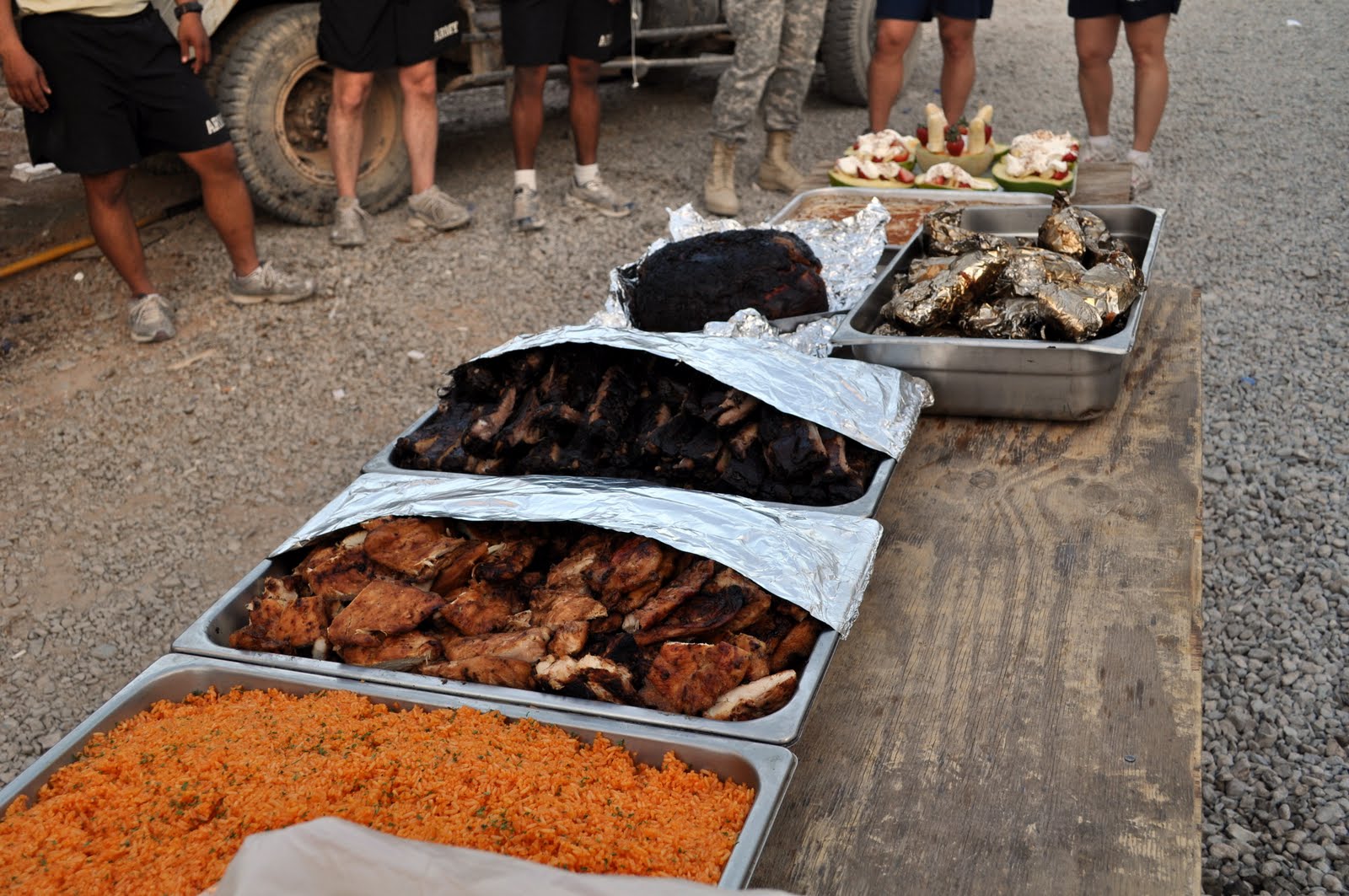
The Guam guys who are here are the second rotation of Guam National Guard to come through Farah, and will be the last. They'll be replaced by Arizona National Guard, who will likely be equally adept at personal protection but much less happy-go-lucky, and who will almost definitely be less likely to barbeque, which the Guamanians do weekly. They've come to the rescue on many a Friday night, when the only choices were starvation or wretched surf-and-turf at the chow hall, with limp fried shrimp and withered lobsters served alongside shoe leather steaks.

Guamanian barbeques (always with lilting steel drum music in the background) were the social highlight of the week, and the Guamanians were excellent cooks. They have an odd penchant for singing the happy birthday song, and every week they'd gather everyone together before eating, run through the ubiquitous Catholic before-meal prayer, and then point to someone in the crowd and shriek out -- "hey, is it your birthday? It's your BIRTHDAY!" and then launch into the song for no reason at all.

(Guamanian food is generally excellent, and they make a corned beef that they smoke and then cook on the grill that's truly outstanding. I will concede that the one time I got miserably sick in Farah was off Guamanian barbequed fish, dredged in a garlic mayonnaise sauce and grilled in a foil packet, served alongside a lemon juice-cured raw fish ceviche that I knew was folly to eat. Both were delicious but desert ceviche was a bridge too far, and I was incapacitated for days. I have no regrets).


A Guamanian barbeque in full swing. The guy in camo clutching a diet soda is there heretofore un-photo-documented Captain Firepower.

I assumed I'd turn this into a photo post, but it turns out that I have very few photos of the Guam guys -- I usually take photos on missions, and they're always on missions but always in the background, pulling security. The photo below was taken just after one of those missions, as they were unloading a .50 cal from an MRAP. "Take a picture," they told me. "It'll make your mother feel better about you being here."
Two Guamanians with a gigantic gun. Feel better, mom?

The guys could start circulating out of Farah as early as Saturday. I'm hoping I can catch up on photographing and blogging about people before the grand exodus begins -- there are hundreds of people who haven't been mentioned here who deserve to be written down, lest I forget them at some point in the future.

On a hillside in stunningly beautiful Purchaman district, Eastern Farah; the truck laden with Afghan Police and Guam guys hadn't been able to handle the grade, and this photo was taken from the window as we drove past them. The Staff Sergeant in the front, one of the SecFor leaders, has an uncanny knack for catching my eye during painfully long meetings and giving me a wink as if to say -- man, I'm glad it's you and not me who's stuck taking notes.

Wednesday, October 20, 2010

Out with the old, in with the...

It's RIPTOA season here at PRT Farah. A RIPTOA -- that's Relief in Place/Transfer of Authority -- happens whenever one military unit transfers out and a new one swoops in to take their place, and they've been happening around me with alarming frequency.

The Italians at PRT Farah were the first to go, with the 9th Alpini replaced by some numbered division of Lagunari, the Italian equivalent of the Marines. The Alpini, who wear awesome but kind of ridiculous feathered fedoras with their formal uniforms -- part alpine woodsman, part keebler elf -- were nice enough guys, but aside from hobnobbing with their commander (a tall and handsome Colonel with a gracious, gentlemanly manner) when we both ended up at the Governor's compound, I rarely interacted with them. The entire compound was invited to their TOA ceremony, though, and would've seemed rude not to see them off, so I went to see what sorts of pomp and circumstance they may have on offer.

I was pretty excited for it. Tragically, though, I've been toying with the idea of running an on-compound marathon and Fridays (our only day off) have by necessity become my distance day, so I ended up going more or less directly from running 20 miles in the desert heat to the TOA ceremony with only a brief shower in between. Consequently, I spent most of the ceremony sitting in the back of the tent trying not to pass out and wondering when it would end. It definitely featured a lot of exciting military parade-type things, like presenting arms and standing at attention, as well as repeated occurrences of a lot of soldiers simultaneously thundering out one word -- it sounded like "Sa! Ba! Do!", which I would translate as "Sat! ur! day!" -- but beyond that it's hard to say exactly what happened. There were a lot of speeches, but the sound system was rigged through tinny speakers that sounded not dissimilar to the drive through at any given fast food joint, and I was too busy taking deep breaths and trying not to throw up to decipher when they were speaking English vice Dari or Italian.

(I later asked an Italian what they hell they were barking out when they all shouted in unison, but he told me in rough-shod English that he hadn't shouted anything -- that only the Lagunari and not the Alpini had been shouting. I tried again -- "right, but what were the Lagunari shouting?" -- but he just thumped his chest and shook his head and said "I -- no Lagunari," and I decided it was best to just let it drop).

Given my physical duress and complete inability to pay attention, I found the Italian TOA to be unsatisfying. I was consequently excited to invite myself along when the PRT commander decided to drive up for the TOA up at RC-West headquarters in Herat, to witness the Italian General whom I'd met a few months prior RIP out and be replaced by another General whose name I never caught. (The military chain of command in my region is something I should know inside and out, and the gaping holes in my knowledge frankly make me question my own bona fides).

We left at five for the drive up to Herat. It's not easy to sleep in the back of an MRAP -- strapped into a five-point harness and wearing a heavy Kevlar helmet -- but I can sleep under any circumstances and napped through the trip, waking up only briefly to stare in rapture at the camels that I still get giddy at spotting. We had car trouble and made it into Camp Arena with only minutes to spare before the TOA, which actually turned out to be ideal because it meant less sitting around and waiting for the thing to start. We were positioned in the back with other Americans, behind the speakers, and I was determined to find out what the Italians were shouting.

But the RC-West TOA was a more staid affair than the one in Farah, with a good handful of speeches but no shouting at all. The sound system was clear, though, and I took notes on what was said, partly because I wanted a record and partly to force myself pay attention. The speakers included the departing Italian General, multiple Afghans, an American 3-star who had flown in for the event, and finally the Italian Minister of Defense, a towering, enormous man in blue pinstripes. They all covered roughly the same ground -- the commitment of the soldiers, the progress that was made, a recognition of those who died, and a nod to the task that still lies ahead. Aside from two dizzyingly fast and powerful-looking fighter jets called Tornadoes screeching by to punctuate the ceremony, it was business-like with little pomp.

(The ceremony was followed by a reception with significant quantities of food and few plates, and I and the PRT's Senior Enlisted Advisor spent the time passing a plate back and forth between us and raiding the smoked meat and Italian cheeses, and I crammed dozens of stuffed olives and fried artichoke hearts into my mouth: such things do not exist in Farah).

The back-to-back Italian TOAs are a harbinger of what's to come: the current PRT, under the command of El Comandante, will RIP out and be replaced by another PRT in just two scant weeks. Everyone here is leaving -- Captain Firepower, Lieutenant Moneybags, and all the rest of the cast of characters will be headed home or to their onward assignment. I'm dreading their departure -- as far as teams go, they're all outstandingly easy to work with, and El Comandante and I in particular have an easy, unspoken synergy that we fell into immediately upon my arrival.

Mercifully, the advance party of the new team has arrived, and they're equal parts laid back and easy to get along with, the kind of guys you'd like to go get a beer with if that were an option here. I'll be with them more or less to the end of my time in Farah, with them ripping out at about the same time that my replacement is slated to arrive.

It's hard not to be sad at grand departure, though -- everyone is busy packing, and some people have countdown calendars with only single-digits left on them. The post office has been jammed with people mailing home boxes of stuff, and I've been on the receiving end of seemingly dozens of half-used bottles of shampoo and moisturizer and the like. Two days ago I snagged a 500-pack of Q-tips that I was desperate for, and today I ended up with a bottle of Creatine powder just for having been in the right place at the right time.

Getting free stuff is always nice, but it only kind of blunts my desire to shriek out take me with you! when people start talking departure logistics in meetings. I know this feeling will pass once the new team is on the ground, but for now, I can't help but find myself pacing the conference room, wondering if there's any extra room on the C-130.

Friday, October 1, 2010

Culture Clash

A not insignificant chunk of the training we go through before arrival focuses on the differences in culture between State and the Military. You can divide us into two opposing columns: we're passive-aggressive; they're hyper-confrontational. We tend to be egalitarian; they focus on rank and discipline. They keep a tidy desk; we live in squalor. Physical fitness matters to them; if we had push-up tests, we'd lose the vast majority of our service. Few foreign service officers smoke; the military loves its cigarettes but REALLY loves its smokeless tobacco.

Having been good friends with the Marines at my last two posts, none of this was new to me. I was a little surprised at how many people here use tobacco products -- everyone smokes cigarettes, all the officers smoke cigars and it seems like every enlisted man has a hunk of chaw in his mouth at any given time -- but beyond that nothing surprised me.

"Foul language," we were told, "is another area where the military isn't like the civilian world. You can expect that the language will be a little salty." This also wasn't news to me -- but I must say that I'm surprised at the the degree to which it's rubbing off on me. I wasn't particularly saintly in my speech habits before this deployment, but I also can't remember ever having dropped the F bomb in a staff meeting. Here, that's closer to de rigeur.

All of this is to say that I anticipate that the language in this blog will continue to go downhill. I don't anticipate studding my writing with obscenities, but as I continue to quote the people around me, the likelihood of using foul language goes up. It is, I suppose, one of the lesser-mentioned dangers of living and working with the military.

Chariots of Fire

Herat is a self-drive city, and I spent the five days of last week's conference being driven around by an amiable but high strung development advisor who's directly embedded with a military maneuver unit. He's got a Peace Corps gone rogue type demeanor, and he had the habit of referring to the military only as GI Joes: "I'm sharing a bathroom with 80 GI Joes," he said. "How many GI Joes you got sharing your bathroom?"

RoguePeaceCorps's style of driving toed the line between aggressive and manic, and he punctuated wild turns of the wheel ("you see how off this alignment is?") with long strings of full-throated but unconventional invective, directed mostly at pedestrians and stray dogs that tried to cross the street. "Shitdog! These kids have a death wish! Son of a … bastard!"

Self-drive is liberating, but there are upsides to riding in steel-plated convoys driven by well-armed Guamanians. Chief amongst them are that we don't get lost (we roll with a fancy GPS system and have a direct link back to an operations center) and we don't deal with checkpoints, since it would take a lot of bravery and some pretty heavy artillery to even attempt to stop a Cougar.

Because we don't deal with checkpoints, I have no idea how they work. It was clear in Herat that there's a system, but it was opaque to me -- sometimes we would dart around the traffic that was waiting at the checkpoints, and at other times we'd stop and wait. Checkpoints are universally acknowledged to be the most dangerous places in Afghanistan, and I found it nerve wracking. RoguePeaceCorps, with his predilection for aggressive driving (at times it seemed like he was using both pedals simultaneously, so erratic was his starting and stopping), didn't help things.

On the first day of the conference, we got stopped at an Italian military checkpoint just as the sun was setting, in between the conference site and the base where we were staying. There was a line of heavy trucks to our right, and we pulled into the oncoming traffic lane to pass them when we hit the seemingly impromptu checkpoint. We were waved to a halt by an Italian soldier in front of an armored humvee, its gun turret pointed in our direction. The Italians, RoguePeaceCorps told us, are known for being quick on the trigger, and he was nervous. "They shoot, man, they just shoot -- but we're sure as fuck not staying here till it gets dark," he said. A tiny Afghan car behind us, carrying far more passengers than the vehicle was intended for, tried to swing out onto a dirt track to beat a wide path around the Italians. They too were flagged to a halt. They put their car in reverse and inched back towards the road, but again got a signal to stop.

RoguePeaceCorps was muttering "this is not good, not good" to himself. He called one of the Operations Centers in Herat, but they weren't tracking any checkpoints. He called the Security Officer for Consulate Herat and was told the same thing. It was unclear if the Italians could see the diplomatic license plate strapped to the back of the sun visor on the passenger side, and equally unclear if such things matter to them at all. RoguePeaceCorps kept inching forward, and the Italians shined a high-powered flashlight in our direction to signal that he should stop. He pounded on the wheel. "What do you want me to DO?" he shouted.

"Those are dazzlers, right?" my USAID colleague from Farah asked me half-jokingly, half-nervously. "You know what comes next, right?" He was referring to the brief we have to sit through in Farah before every mission we go on; some slides never change, and the Rules of Engagement slide is one of them:

You have the inherent right of self defense. You must have positive identification before firing. Do not fire on historical sites or lines of communication. Escalation of force: Step One -- warning. Hand and arm signals. Step two: enhanced warning. Dazzlers.

The Italians were at step two, using dazzlers, and that put us only one step away from step three:

Step Three: Lethal Force. Shoot to disable, shoot to kill.

There's a feeling of helplessness in all of this that's hard to communicate. You're staring at a gun turret being manned by a military force that's considered quick on the trigger, and they appear to have escalated their warnings up to just shy of using lethal force; the driver isn't sure what to do, the sun is setting and everyone's on edge, and meanwhile you're stuck in the back seat while someone else has their foot on the gas pedal. You can't poke your head out the window and ask what you're supposed to do, because the windows don't go down on armored cars and even if they did, putting your head out of the armor and into the line of fire feels like it would be suicidal. You're pretty sure that you'd have ground the car to a halt by this point, but it's still inching forward and you don't have your foot on the gas pedal.

They hit us with the dazzlers again, and RoguePeaceCorps hit the brakes definitively. My heart was pounding. The Italians seemed to be waving us off the road onto the dirt path the local car had tried to take earlier. "I think they want you to go around," someone said. "Through fucking IED land over there? No fucking WAY, man!" RoguePeaceCorps responded. The local car that had tried to veer off earlier cut through the brush. We stared at the Italians, and they continued waving their hands and signaling with the dazzlers that we should be moving. Not moving seemed as bad as moving. My heart was still pounding.

We waited a few minutes more, and cars from the other side of the checkpoint that has also been directed around started arriving at our side. "If they made it without blowing up, we should be ok," RoguePeaceCorps said. We pulled off and eased our way through the scrub. We passed by the checkpoint and saw that the humvee blocking traffic had indeed had a 240-Bravo with its muzzle pointed directly at where our car had been stopped. It was guarding an Italian truck that had broken down and was stopped with the hood popped open. We made it back onto paved road and sped back to base, arriving before sunset.

Journalists have accused US forces of seeing the war through the periscope of armored vehicles, fully unaware of ground truths because we are unwilling to put ourselves on the streets without a significant protective layer. People in Herat say that being in a self-drive city is liberating, with the freedom to go wherever they want or need at any time without the advance notice required to scramble a convoy. I can see where both of them are coming from, but at the end of the day I have no complaints about having a military escort and an inch of steel between me and the outside world.

Tuesday, September 21, 2010

Blatent Plagiarism

I don't intend to turn this into a photo blog. I've always been more of a writer than a photographer (I am aware that I have little skill with a camera), and my favorite blogs have always had more words than pictures.

That said, between the elections, Burn a Koran Day, and the PRT's own internal travel schedule, I've been swamped, and the last thing I've wanted to do when I get home is sit down and write. I keep telling myself I'll catch up, but it's unclear when that's going to happen.

I'm sprinting off again tomorrow to a conference that will be interesting from a work standpoint, but that will also be something of a mini-vacation inside Afghanistan. I was asked to give a presentation on political reporting, which has been a good chunk of my baileywick here in Farah. I made a powerpoint as a matter of course, but since powerpoint is the worst medium on earth, I kept the words to a minimum and included a photo on each slide. The majority of the photos were stolen from our PRT's photographer, Senior Airman Paparazzi. He's an incredible photographer, award winning within the military, and stealing from him is far better than wading through the thousands of bad photos I've taken here.

I keep telling myself that one of these days I'll catch up on writing. In the mean time, though, I thought I'd toss up a few of Airman Paparazzi's photos from our recent trip to the farflung mountains of Eastern Farah, as a placeholder until I actually get around to writing about it. None of these are necessarily representative of the district we were in -- but they're such perfect photos from a composition standpoint that I can't tear my eyes away from them.


In advance of the elections, these sorts of posters were everywhere. They each carry the candidates name and photo, a brief statement, and the candidate's number and symbol, a common practice in countries with high illiteracy rates.


This policeman was one of several guards posted during the district shura we were attending.


The huge cloud of dust is from a helicopter landing in a dirt field, not an explosion. I had exited a different helicopter in advance of this one landing.

Sunday, September 19, 2010

Way better than United. Even in Business Class. Seriously.

I've been traveling a ton lately. After riding several different aircraft, my previous suspicions have been confirmed:


Blackhawk is the only way to fly.

Monday, September 13, 2010

Terry Jones and the Unravelling of Sanity

The end of Ramadan and Eid-ul-Fitr coincided with the anniversary of 9/11, which likewise coincided with International Burn a Koran Day. The timing couldn't have been worse.

Eid-ul-Fitr marks the end of Ramadan, the holiest month in the Islamic calendar. Ramadan is the month in which the Koran was descended to Mohammad via the angel Gabriel, beginning in roughly the year 610, in a cave on the outskirts of the city of Mecca. ("Descended" -- nas'l shud -- is the verb in Farsi used when describing the process by which the Koran was revealed to Mohammad). The name Koran, or Qur'an, means "the Recitation," and derives from the first word of the first chapter revealed to Mohammad, the opening of Sura 96:

Recite! In the name of thy Lord and Cherisher, who created --
created man from a mere clot of blood.

Terry Jones, the fringe pastor with a congregation of about 30 people who drew the world's ire with his Burn a Koran Day plan, is proud to say that he's never read the Koran.

My personal thoughts on Burn a Koran Day are unimportant, though I fully agree with the Secretary's statements that the whole idea is disrespectful, intolerant and divisive, worthy of being condemned. The whole thing is coupled with more of a shaking sense of outrage, a disbelieving, head shaking, how-dare-you sort of wrath, for both the idiotic act of burning Korans and for the direct disregard for the lives of thousands of people around the globe. I am not surprised that appealing to reason ("what you're doing is offensive and wrong") -- didn't get much traction, but it honestly makes me clench up in anger that Petraeus's appeal to conscience ("you're putting our troops directly into danger") was equally ignored.

(Quoth Captain Firepower: "If I ever meet that guy, he's gonna get his jaw broken. I believe in free speech, but if you're gonna say some stupid shit, you've gotta be able to take a fist for what you believe in.")

Burn a Koran Day echoed through Afghanistan, and Farah was no exception. It took a few days for the news to reach us -- word travels slowly to the Afghan hinterlands -- but when it did arrive, it resulted in protests, mostly in the outlying districts. If Burn a Koran Day had actually taken place, it would've been much worse, Obama and Petraeus's denunciations thereof notwithstanding.

As it was, it was nerve-wrackingly tense -- not from a personal security standpoint (I have great faith in our FOB's perimeter defense), but just from the idea that SOMETHING might happen. Any of the would-be situations that might have occurred in conjunction with Burn a Koran Day would ultimately have been a lose-lose us. That something could have been riots outside our gates, or major protests in the city, or a heavy-handed police response or warning shots gone wrong, or even just a roiling mass of angry people that eventually shouted themselves out and went home peacefully; even in the best-case scenarios have no upsides for us -- none of it would have inched Afghanistan closer to self-sustaining stability, or improved the lives of anyone or upped the standing of the Afghan Government or America in the eyes of the Afghan people. That, more than anything, is what Terry Jones does not understand about his idiotic Burn a Koran Day publicity stunt: that in pointlessly infuriating Muslims around the globe, he has not only endangered our lives, but also made a nearly-impossible job that much more difficult.

Burn a Koran Day was cancelled, but there were still isolated protests around the province. We were overrun with requests for information on them, and I spent the day trying to figure out what was rumor and hearsay (2,000 people, spun into a frenzy by during prayers, three people killed) and what we actually knew for certain (200 to 300-person protested outside a NATO Combat Outpost; four wounded by warning shots fired by Afghan police, one of whom later succumbed to his wounds), and fielding questions from the Embassy and DC about what was happening.

The protests largely fizzled after a day, and September 11th itself, the National Day of Remembrance, was quiet. There was a memorial service on compound at 8:46, the time the first plane hit the north tower. It was held in front of a hand-made memorial with a sculpture of the towers made of plywood, painted grey and adorned with flags and a timeline of the events of 9/11; just in front of the towers was a rusted chunk of twisted metal, taken from the towers themselves. The memorial was made by two army Captains (one current, one former) who lost relatives to the World Trade Center on 9/11 -- a father who was a New York City firefighter, and a brother whose office was on the 101st floor. It all comes full circle: from New York to Afghanistan, where it all started.

Tuesday, September 7, 2010

As far as call signs go, it could be worse.

I'm behind on blogging. I've been running ragged for the past few days, ankle deep in meetings and reports, and traveling a considerable amount both inside and outside the province. There's a lot to write about, but there's also a lot that can't be said on the blog; hopefully I'll catch up over Eid.

Eid -- that is, Eid-ul-Fitr, literally "the celebration of the breaking of fast" -- is the three-day holiday that's coming up roughly this weekend, to mark the end of the holy month of Ramadan. Muslims spend the month abstaining from food, drink and tobacco from sunrise to sunset, and it's always a difficult month, even if you're not fasting. Work days are generally cut in half for most Afghans, making it hard to get things done, and you can't help but feel bad for people sweltering during the long summer days without even water to drink. There's an oblique sense of guilt that accompanies having lunch or slugging back a surreptitious diet soda, even if it's only done in the privacy of the compound where few Afghan eyes can see.

We held an Iftar last night, the traditional celebratory meal eaten at the end of a day of fasting during Ramadan. It was a huge event -- a dinner for over 50 Afghans, held outside on rented carpets intended for weddings. We catered Afghan food (cinnamon-spiked basmati rice, whole roasted chickens, a side of meatballs and Afghan flatbread), and supplemented it with food from the chow hall that we know our Afghan counterparts enjoy but rarely get -- beef stew, fish in a lemon-butter sauce, chicken fingers, and a side of sweet corn.

About half the guests, just after breaking the fast. People were still arriving as the sun set, and most of the Americans were still outside greeting people.


It was a beautiful event, made more so by a lucky streak of perfect weather -- no driving dust or sandstorms, just a light breeze and relatively cool temperatures. It took the entire team to put it on -- security ringing the perimeter, and everyone else pitching in to do whatever needed done -- helping set the "tables" (carpets on the ground, covered in traditional Afghan eating cloths called dastarkhuan), or plate rice and meatballs, or lay out sodas. I was a little panicky about the entire event, and my constantly calling audibles left Sergeant Charlie (a Vietnamese-American who labeled the fridge in the Civil-Military Operations Center with a sign that reads "replace the water you take: Charlie is watching you") referring to me as "Bridezilla."

I will concede that I was picky on things like soda distribution -- I wanted them all in a cooler, not set out at individual places; who can know if our guests want an orange or a strawberry flavored Fanta, or a regular pepsi or a diet? I also had a lot to say about the placement of table cloths and the distribution of rice and fish and chicken fingers; the person tapped to be in charge of food, a Navy culinary specialist with a degree from Johnson and Wales (Petty Officer Frying Pan, if you will, although I'm reserving the right to change that nickname at a later point in time) was thrilled with my micromanagement, let me tell you.

Regardless, Bridezilla will stand by many of his requests: "can you move the MRAP so it blocks that broken down car up on blocks right in front of the entrance?" and "can that Air Force girl ditch her M-16 somewhere before the Afghans get here?" hardly seem unreasonable to me.

The Commander of the PRT (El Comandante, if you will), greeting an Afghan entering the FOB.

Thursday, August 26, 2010

Pie in the Sky

The weather in Farah since my arrival has been blue skies and hot wind, with the relative clarity of the day depending on how much dust the wind kicks up. Everyone has commented on how cool it's been relative to before my arrival, with temperatures in the 100s but never topping 110 and only one day that was so truly brutally scorching that it felt like the earth had moved closer to the sun.

We've been hit by a series of sandstorms over the past few days, with wind whipping through the valley and driving fine sand into your eyes, the dust blotting out the mountains in the background. It's still hot, but the sun feels dimmer in the mornings. Flights have been grounded, and you can't help but feel constantly unclean from the layer of grit that accumulates in your hair over the course of the day.

It's been about a month since I've seen clouds. There are, on very rare mornings, a few wisps of cirrus off in the distance above the mountains, but for the most part the sky is an empty blue. There's just not enough moisture.

This morning the sky was completely clouded over with ominous grey storm clouds, the first I've seen in a month. It actually made me a little panicky, and I thought about going back to the barracks and waiting it out -- like clouds were enough that work would be cancelled due to inclement weather. "It looks like it's going to rain," I said to my coworkers. "It won't," they replied. "It already rained this year, and you missed it."

Wednesday, August 25, 2010

Here today, Guam tomorrow.

The Med Unit held a Combat Life Support -- CLS -- refresher for the SecFor guys a few days ago, and they let me tag along to try to pick up some pointers. I had gotten a two-day intro to CLS before I came to Afghanistan and loved it, and I was grateful that they let me sit in for the refresher even though I was never officially certified. It also shows a certain willingness to pitch in during emergencies rather than just being cargo; "good that you're trying to be more than just self-loading baggage," the XO said.

The SecFor guys can't shake their happy-go-lucky nature, so CLS class was a quick classroom refresher followed by an hour of cavorting in the sun for the practical exercise. The classroom time really just sought to reinforce the need to tourniquet early and often, although I did learn a few new and exciting medical nuggets. For example:

-- If bullets are still flying, everyone -- including the medics -- should be shooting back. "The single best medicine on any given battlefield is FIRE SUPERIORITY," we were told.

-- All CLS certified personnel can put in IVs. Generally speaking, CLS-certified personnel shouldn't bother putting in IVs, since too often people get distractedly obsessed with doing so and the patient bleeds to death while they're looking for the vein. (I never learned to put in IVs; doc promised to teach me if I swing by the Med Unit).

-- Don't get shot in the chest. That's really the big take home message of combat medicine. If you get shot in the chest, you'll probably end up with a sucking chest wound, and then air will build up in the chest cavity, and then the medics will have to stab you in the chest, through the ribs, with a gigantic, 14-gauge hollow needle to relieve the pressure so your lung doesn't collapse. "You'll thank them," the instructor told us. I'm not sure I believe that.

After classroom time, we walked down to the running trail. It was a perfect day for hanging out in the dust practicing medicine -- sunny and clear, hot with just a little bit of breeze. We split into groups of five, and I invited myself along with four of the Guam guys rather than sticking with the one other civilian who'd been in the training. The Guamanians bring a laid-back, fun-loving island attitude to everything they do, and it made it hard to recreate the actual stress of real-world combat medicine. "Trust me," the instructor said. "Doing this during actual combat SUCKS."

We started at the tourniquet station, but it was a little chaotic as people were still dividing into groups and figuring out where they should go, and we weren't sure if we should start or not. "Do you have any questions about tourniquets?" the instructor at the station asked. No one did. Before anyone could practice putting one on, the medic leading the training shouted "ROTATE! GO! GO! GO! Combat HUSTLE!"

My group took "Combat HUSTLE!" to mean "sprint between stations," and we did -- the Guam guys shouting GO! GO! GO! GO! GO! the entire way.

We arrived en mass at the stretcher station. "That sergeant over there is down and needs a stretcher!" the instructor said, waving towards a guy reclining in the dust. "Go get him!" The stretchers are stored folded into a small square, and getting them extended out to a usable format is apparently difficult; you have to unfold it, pull on it, and then twist the handles simultaneously to get a flat platform on which the patient can rest. The Guam guys wrestled with it for about 20 seconds when another group (slower than ours -- they apparently didn't get the "combat hustle" memo) showed up. "Looks like we're double booked," the instructor said. "You guys can go ahead and rotate."

As soon as she said the word rotate, the Guam guys started shouting "GO! GO! GO!" again, and we were off, sprinting like idiots. The instructor for the next station was standing next to mound of dirt, not unlike a snow-fort you might make if were living in place that had snow instead of several inches of hot dust on the ground. "All right!" said the instructor. "One of you has been shot in the chest!" I clutched my chest and threw myself theatrically into the dirt, hyperventilating. "I've been shot in the chest!" I shouted. "DAKOTA'S BEEN SHOT IN THE CHEST!" the Guam guys shouted. "Bang bang!" said the instructor. "They're shooting at you!"

One of the Guam guys grabbed me from behind, sliding his arms under my armpits and lifting me from the shoulders; another grabbed my legs at the knee, and the two of them picked me up more or less effortlessly and carried me behind the dirt pile. They dropped me and then joined the other guys, who were peering over the top of the dirt pile with index fingers and thumbs extended, pantomiming shooting and shouting "bang bang bang bang bang!" (Only one of the four pantomimed holding a rifle; finger pistols were the order of the day). "Ok!" shouted the instructor. "Treat the patient!"

They got out a kind of bandage made of plastic called a chest seal ("wounds from neck to navel get a piece of plastic"), pressed one to the front of my chest and the other to the back where the exit wound would be. "Anything else?" the instructor asked. "NEEDLE DECOMPRESSION!" they shouted simultaneously. (One thing's for sure: you can't fault the Guam guys for enthusiasm). They got out the ridiculous needle for chest decompression, counted down the correct number of ribs, and then indicated they'd stab it in right there. "Good," said the instructor. "Not good," I said. "You didn't say anything about anesthetic."

"ROTATE!" they called, and off we sprinted.

The next station was on pressure bandaging. "Your buddy's bleeding heavily from the arm and leg! Fix him up!" the instructor said, waving to another instructor lying on the ground. Two of the Guam guys sprung into action, one with an Israeli bandage (a wrap with a piece of plastic embedded in it to act as a fulcrum for putting pressure on wounds) and the other with quick-clot laced bandages and an ace wrap. It quickly appeared to devolve into a competition to see who could use the most gauze, resulting in a mummy-like conglomeration that may or may not have been effective stopping blood flow but that was definitely fun to look at. "We would've just tourniqueted him anyways," they said.

Pressure bandaging was the last stop, and all the groups came back together; it had been a fun training and everyone was in a good mood, laughing, drinking water, and standing in the shade of the ambulance practicing different ways of carrying patients. "Fireman's carry!" they shouted. "Assisted walking! Doberman!"

"What's the Doberman?" I asked. "Well, you get down on all fours and straddle the patient," I was told. "He wraps his arms around your neck, and you drag him forward on all fours, like you're a doberman." One guy threw himself on the ground to demonstrate, lying face up on his back in the dirt. The other guy got down on all fours on top of the patient, as promised, and the patient put his arms around his neck and interlocked his fingers so he could be dragged forward. The medic took about single step, dragging the patient about a foot. The patient shrieked and let go -- apparently the act of dragging him had filled up the seat of his pants with a good amount of hot, fine-powder dust.

"All right, listen up!" the lead medic shouted. "We're not done! There was an IED attack! We've got a MasCal! The patients are just over that hill -- GO! You've got FIVE MINUTES till the med-evac birds get here!"

(A MasCal is a "MASs CasuALty event." The wonkiness of the abbreviation had never occurred to me until I typed it out).

We all ran over the hill, and all the medics who had previously been stations instructors had arranged themselves in various positions. I was in the first wave that scattered to deal with patients, while a second wave ran off to get supplies. I took the farthest patient, a guy who'd pulled his foot up into his pants to simulate losing a foot. I took his tourniquet from him -- everyone carries a first aid kit for the medics to use; you in essence carry your own medical supplies to be used on yourself -- and put it on his leg as instructed, as close to the joint as possible.

"Too high," he told me. "For a foot wound like this, you'd want it lower, so more of the leg could be saved once they got me into surgery." I moved it to below the knee. The lead medic came up behind me, stopping briefly to grab a shoe ("Didja lose this?" she asked the patient) before heading over. "Tourniquet's WAY too low," she told me. "Put it as close to the joint as possible." I looked at the patient and he looked sheepish, and I moved the tourniquet. Just then, two helicopters flew over head. "The birds are here! Move the patients! GO GO GO!" (The helicopters weren't part of the training; it just so happens that the running trail abuts one of the helipads, and the trainers got lucky in the timing of the landing).

A Guamanian ran up with a stretcher. They loaded the patient on and then started jogging him towards the ambulance. "Combat speed!" they said, promptly dropping him into the dust. "Try again!" they shouted, hauling him back up and, eventually, wobblingly, over the finish line.

CLS training was outstandingly fun and a good little refresher of how to use everything in the med kits we all carry, but I largely put it out of my mind until I got an email this morning, asking if I'd mind if Public Affairs used my photo in their newsletter. They try to find bizarre looking photos for the newsletter and then have people write in with captions for them, a la the New Yorker. A shot of me and one of the Guam guys sprinting between stations had been chosen. "Everyone," they told me, "will appreciate what appears to be a random civilian being chased by a crazed Guamanian."

I for one look forward to the captions.

Sunday, August 22, 2010

So Much for That "Fitness" Merit Badge

I vowed before arriving in Afghanistan that I'd leave in better shape than I arrived. With not much to do in the evenings except hit the gym, it seemed like departure with a respectable physique was in the bag. But I was in the SecFor office just two days ago when I stumbled across an entire case of Tagalongs -- the chocolate-covered, peanut-butter filled shortbread girl scouts cookies. Tagalongs, as far as I'm concerned, are god's food, perfect in every way. I could make a meal out of Tagalongs, if doing so wouldn't cause your heart to explode out of your chest and deflate on the table in front of you. "Who do I need to beg for one of these cookies?" I asked.

"Dude, just take a box," Captain Firepower* told me. "They're not anybody's. We've got cases lying around -- they just show up in the mail. The girl scouts are…" (and here he grinned) "…very patriotic."

So I took a box and devoured a quarter of it on the spot, fingers covered in the outer chocolate made soft by the desert heat. But then that whole fitness goal came back to mind, and I guiltily decided to drop the rest off in the office next door to mine, where they had previous complained that my predecessor was a "net subtractor" from the office snack pool. "Be an adder, not a subtractor," they had told me, and Girl Scout cookies seemed like the sort of thing that would make me a hero and ensure that I could continue pilfering from them for the foreseeable future.

I strolled into their office brandishing the cookies and announced that I had great news. "I brought some Tagalongs," I said with flourish. "You'll note that I'm being an adder, not a subtractor."

"Oh god, more Girl Scout cookies?" they said. "There's a whole case of them under the TV. We put them away when we all started to get fat." I examined the area under the TV, and sure enough there were some 20 boxes of Girl Scout cookies -- Samoas, Do-si-Dos, more Tagalongs, a few flavors I hadn't even seen before. I ripped open a box of Samoas (my favorite!), shoveled two into my mouth at light speed and then put the rest next to the Tagalongs. I was almost dizzy at the idea of an all-you-can-eat smorgasbord of free Girl Scout cookies.

And now it's two days later. I've eaten more cookies in the past 48 hours than I probably have in the last two years. My Grand Master Plan involving healthy living and plenty of push-ups has largely been supplanted by a world where Girl Scout-endorsed shortbread products almost literally grow on trees. The guys next door have vowed to put the cookies away ("damn you for bringing these out again," they said), and part of me is hopeful that they will; the other part of me, though is wondering why anyone would bother striving for visible abdominal muscles when there are Thin Mints to be had.

*Captain Firepower is the plucky young captain in charge of ensuring we've got enough firepower on missions. I'm moving to a nickname only policy in this blog.

Friday, August 20, 2010

In Memoriam

There was a casualty on August 17th, the first since I joined the PRT. He was a member of EOD, Explosive Ordnance Disposal, the bomb squads made famous by the movie The Hurt Locker. He was on the team called when three IEDs were found in the Shewan district of Bala Boluk, where I had been just a few weeks prior; he had apparently defused one of the bombs and then picked it up to move it to another location for a safe, controlled detonation, as is common practice. It exploded, killing him instantly.

I had seen him around base but can't say that I knew him -- we had never spoken. Press releases said that he'd previously won a purple heart in Iraq when the shockwave from a bomb had perforated his eardrum, leaving him deaf on one side. He was, by all accounts, well liked, and a lot of the members of PRT had hung out with him. Even without having known him, it's hard not to be affected by the quiet, almost disbelieving sense of loss on base. There's always hope that he'll be the last, but I can't imagine how I'll take it in the future if it happens to someone I know. He was two weeks away from finishing his tour.

His name was Derek. He was 24 years old.

Tuesday, August 17, 2010

Annie Get Your...

Every trip off base is considered a mission, and every mission is preceded by a convoy brief. Much of each brief is repetition, and my favorite part that's always repeated is the slide on the "principles of fire control." The first bullet points, high at the top, instruct one to destroy the greatest threat first while avoiding target overkill -- "one shot, one kill, hooah? Hooah." The final bullet point, way at the bottom -- almost like a suggestion or a plaintive request -- is to avoid fratricide.

("It should go without saying," the Commander told me when I asked why it was so low on the list. "But you did say it," I pointed out. No change to the slides).

During the Embassy in-brief, they remind gun-qualified people not to carry on compound unless they're specifically part of the perimeter defense plan -- to avoid not fratricide, but rather "a blue-on-blue incident," a euphemism I find pleasant.

Every uniformed American is required to carry a gun at all times except while exercising. For most people that's either an M4 or M16 rifle or a pistol worn in a holster under the armpit, strapped to the thigh or tucked into their waistband. A few unlucky people are stuck lugging around guns that are large enough to require kickstands to operate, like the 240B ("two-forty Bravo"), and it's odd to see them in essence hauling a large piece of machinery around with them to the chow hall or laundry room. Odder still is to see a rifle dangling by its strap on the towel hooks outside the showers, or the barrel of a rifle poking an inch or two out from under the shower curtains that partition off the stalls in the restroom.

The Lieutenant in charge of giving out money ("Lieutenant Moneybags"), next to a pile of guns.

Sunday, August 15, 2010

The Bases of Greater Herat

It took five hours to cover the 250 kilometers between Farah and Herat, the cultural capital of Afghanistan and home to mosques, minarets and my boss. I had been pretty excited about the trip for a number of reasons, not least of all being that I was finally going to get to see the fabled Blue Mosque of Herat. I'd been scheming to get to said mosque since my failed efforts to sneak into Afghanistan while traveling after my junior year in college, when I was a carefree idiot and the Taliban were still in charge.

But of course I didn't make it to the Blue Mosque -- which, I discovered after some mournful googling, is actually called the Jumah ("Friday") Mosque, to avoid confusion with another Blue Mosque in Afghanistan, in Balkh province in the north. I didn't actually make it into Herat proper at all: our trip was exclusively to military bases on the outskirts of the city, first to Camp Stone (run by the Americans, with a chow hall that stocks both excellent onion rings and non-alcoholic beer), and then on to the heart of things at Regional Command West (RC-West, if you will) headquarters at Camp Arena, co-run by the Spaniards and Italians.

It was definitely an interesting trip, tagging along with the Commander of our PRT to his meetings to provide the governance-focused civilian view on things. We had scores of meetings, the most important of which was with the general in charge of RC-West -- a stately, handsome Italian one-star named Claudio Berto who looks exactly like you'd expect an Italian general to look. After years of working at huge embassies (tiny cog, enormous machine), it was definitely odd to be one of two people sitting down with a general in charge of thousands and thousands of soldiers, and to have my opinion matter to him.

I am slated to head back to Herat in September, and am determined to see the blue mosque come hell or high water. In the mean time, I was more than content with a truly excellent pizza, a half dozen espressos crammed into a 24-hour time frame, and a ride home that happened to pass by a small herd of wild camels.

Tuesday, August 10, 2010

Well, it was fun while it lasted.


I made it just over two months without trimming the hair on my chin. The photo above, helmet hair and all, is the end result of that effort: a decently commanding and certainly respectable beard. Afghans approved.

But the long hair on my chin was remarkably annoying while wearing a helmet -- the two-pronged chin strap curls the facial hair back under and makes your whole face itch. I also felt like the beard was getting some pretty unattractive 3-D puffiness to it that had to go.

I'm headed off to another city tomorrow to meet my boss. He's about 250 kilometers away from me, and I've been in country almost a month without having met him; the beard trimming was in no small part an attempt at respectability in advance of that meeting. The base he's located at is run by the Italians and is known for its pizza and excellent chow hall; I've only been in Farah about three weeks, but I can't pretend I'm not excited about that.

I do feel oddly naked with most of my facial hair gone, though, and a resurgence may very well be forthcoming.

Monday, August 9, 2010

Dust and Soil: Bakwa

Yesterday I went to my second province outside of Farah City Center: Bakwa.

"Ah, you're going to Bakwa, eh?" said the Doc. "It's, um, pretty bleak." "Bakwa?" said the coarse-mouthed First Lieutenant in charge of giving out money. "That place sucks balls."

I was again tagging along with our Ag guy, who was going to hold a shura (an Afghan community gathering, like a town hall) to discuss deep irrigation wells. I wanted to talk elections -- just to check the pulse in a rural area and see if anyone had any interest whatsoever.

Bakwa is very much a disputed district. The Marines have put in a lot of effort, but it's still a toss up on security, and some of parts of the district still have distinct Taliban leanings. There's little water but excellent soil, two conditions that make opium an attractive cash crop, and the district is one of the major poppy producers in the region.

This is what they're fighting over:


Taken from the window of a Cougar on the three-hour, forty-kilometer drive to Bakwa.


It was admittedly not all so bleak as that, and there were the odd splashes of green and a few strategically placed mud huts here and there. For the most part, though, it was wide open nothingness.

Also from the window; touched up to remove a bit of the glare, which definitely upped the color.


It was 120 degrees when arrived at Bakwa's district center, a sun-baked, trash-filled empty lot; I exited the Cougar next to a pile of burnt cans and chicken feathers, next to some cast-off concertina wire. We were in the "city center," though in reality there is no city, and not much of a district center, either. People come in from time to time to have meetings, but almost no one lives there, and even the village opposite is abandoned. The Marines, at the request of the populace, kicked out the Taliban and fixed up the central bazaar, but there are few merchants and even fewer shoppers. "We cleaned it up for you -- there's a butcher, a baker, some shops," they said during the shura. "If you don't shop there, the merchants are going to give up and go away."

The parking lot.


The actual district center, where shuras and meetings are held, was reasonably nice, filled with chairs and carpets; twenty five Afghan elders were waiting inside to talk about deep irrigation wells.


The entrance to the district center. The red words on the right read "in the name of God;" the white on the left is the beginning of the words "Welcome to the peaceful city of Bakwa."


Doc had warned me that every time he goes to Bakwa he ends up getting mortared; the Marines are fully tuned in to the sound of rocket attacks, and I was set to be the first one to hit the deck the second they shouted "incoming." But they never did: the population of Bakwa, no matter their political bent, wants deep irrigation wells more than anything. Ag (in lieu of his name, I'm going with his position) explained that at this time, the PRT can only fund twenty wells, and that the district leader, in negotiations with individual villages, would be in charge of determining where they would go. Farmers would be required to swear that they will not use the wells for opium production. Ag acknowledged that twenty wells isn't enough for everyone, but it's a start.

I briefly talked elections (a topic on which I will say nothing until after they take place on September 18). Our Marine liaison officer reminded the elders that continued funding for projects -- like the solar street lights previously installed, the upcoming deep irrigation wells, and a potential future program for fertilizer distribution -- were contingent on the continued support of the people for the Government of Afghanistan, and not the Taliban.

And then we had lunch. Bakwa is known for its wheat and Afghans, to the fullest extent of their ability, are definitely foodies with surprisingly refined palettes; stone-ground Bakwa flour is considered to make better bread (Indian-style naan, cooked quickly in a hot clay oven) than what's found in Farah city. The bread accompanied chicken and potatoes in an tomato-lentil sauce, and was indeed better than what we have in the city. ("Our bread tastes like feet," said the First Lieutenant, "except when it tastes like potting soil.")

Quoth the Gunny of the Marines: "this is a hundred dollar meal. You believe that? I gave them a hundred bucks. For this. WHERE'S THE RICE?" It appeared that the organizer of the shura had absconded with the remainder of the money, and I seconded the gunny's feeling: Afghan rice is ridiculously good.

I wandered outside to take a few more photographs (SecFor followed close behind; "you're not allowed to wander off alone, sir"). We weren't attacked or shelled, we got some work done, and I got a couple photographs of a pretty desolate place.

I secretly love this picture.


And that was that.

Friday, August 6, 2010

Fields and Canals: Shewan

My first trip out of Farah city was to Bala Boluk (literally "Upper Block") district, due northeast of our FOB. We were headed out to a series of villages near the town of Shewan to check on some USG-funded water projects -- a stream diversion project to keep the Farah river (the "Farah Rud," in Pashto) from eroding a town wall near Shewan itself; a dam-like "superpass" that will facilitate irrigation near the town of Tahksirak, and another canal-related project in the village of Shia Jinggal.

These villages are tiny, and there's no hope of knowing where they are. You won't find them on common maps of Afghanistan, and I include the names here only because I find them mellifluous and pleasant-sounding. Because of the Farsi influence, almost all place names have the stress on the last syllable; Shia Jing-GAL, Tahk-sirAK. Farah is no exception -- it rhymes with "hurrah," not with Sarah.

I was tagging along with our Department of Ag rep, a soft-spoken, good-natured Texan with an easy smile and a light southern accent. He's pleasantly self-effacing, but with a comprehensive knowledge of all things agricultural, he's arguably the most important civilian in bucolic Farah: he knows when and how to organize seed distributions, what sorts of fertilizers to hand out, how to drill wells and run irrigation lines. The link between poppy sales and Taliban funding makes poppy eradication and replacement high on the list of USG priorities; the PRT does a lot of Ag outreach.

The road to Shewan is paved for the majority of the trip, making it a relatively pleasant and quick jaunt through dusty fields of nothing -- about an hour and a half to cover about forty miles. The city itself used to be firmly owned by the Taliban, but the Marines booted them out and the PRT was quick to move in with quality-of-life projects; the waterworks that we were headed to are part of that.

We were supposed to meet the contractor in Shewan's city center and follow him to the stream diversion project, but he no-showed us. We tried to call him, and then to get through to him with the help of our Afghan assistant. No dice. The Lieutenant who's generally in charge of doling out money like candy notices that trucks -- tiny little Mazda pick ups -- were passing by laden with rocks, and he flagged one down. Through a Pashto translator, he determined that they were going to our water project. They agree to let us follow them; some officers from the Afghan National Police (the ANP) came along as well.

Here was the problem: we were not in cars. We were not in armored cars or up-armored Humvees, which themselves are pretty massive vehicles. We weren't even in MRAPs, Mine-Resistant Anti-Penetration vehicles, heavy trucks with a V-shaped bottom that explosions deflect up and away from.

We were in Cougars.


Cougars are massive vehicles that appear to be made from converted tractor-trailors, draped in inches of steel and so fully blast-resistant that insurgent rarely bother to waste their explosives on us, preferring softer targets. (If you look closely in the picture below, you'll note that SecFor has attached a Guamanian flag somewhere on each of the Cougars -- either on one of the antennas, or under the covering on the gunner's turret). They're enormous.


We were off the road for about four minutes when we got stuck.

I wasn't sure what was going on; generally speaking, the passengers are forbidden from getting out until the door is opened by SecFor. There aren't a ton of windows in the back of a cougar, and the five-point harness seatbelt keeps you pretty firmly tied down. And it's pretty unlikely that I, the least handy person on earth, would be of much help.

They eventually tied the bumper to the front of another cougar and bump-pulled it out of the gulch it was stuck in. We pulled into the riverbed of the Farah Rud -- it dries up in the dead heat of summer -- and drove to the project.

It was 110 degrees at 11 in the morning, but the project hands were happy to see us, and they pointed out what they'd done. The project is a community effort involving something called gabions -- strong, four-foot wire baskets woven by women in the cities and then filled with rocks by the men; they're stacked to create walls to divert the stream. Having women weave the raw materials for the project and the men provide the labor makes both genders stakeholders in the project -- something rare in Afghanistan. It also ups the number of people involved, providing both livelihood and a means of occupying otherwise idle paws.

A policeman, friends with one of the workers, pointed to a distant building across the flat, rock-strewn brush. "The Taliban were there two days ago," he said. "They shot at us, but we wounded two of them." I asked if they planned to stop work because of the threat and he shook his head. "They're always threatening," he said. "They told even told the shepherd to stop taking his goats around. They're not reasonable."

We walked down the bank of the river for a bit, past a massive marijuana field that probably covered the area of half a football field. Aside from the tiny plants that grow wild on the compound of US Embassy Islamabad -- DEA assured us it was low quality -- I'd never seen it cultivated before. "This is nothing," said the plucky captain in charge of ensuring that there's enough firepower on each of our missions. "It'll be shoulder high in a few months." He's in the army and by extension not a pot smoker, but he exudes West Coast and I don't doubt him.

Despite supporting agriculture projects in the hopes of finding viable alternatives to growing narcotics, the PRT is not in the business of drug enforcement. Dealing with a half a football field's worth of pot -- which, our translators assured us, is likely only for personal use -- is well out of our jurisdiction. We walk away.

The next project is in Shia Jinggal and as we're pulling up, the gunner leans down from his seat and calls out, "just so you know, sir -- this isn't exactly a friendly neighborhood."

Shia Jinggal is an ancient sun-baked mud-brick village with a single narrow street running the length of it. It was beautiful, albeit spare; I cursed myself for forgetting my camera. The surrounding area was lain with opium fields, harvested a few months prior; there were poppy stalks drying for next year's seed at the entrance to the village.

It was eerily empty, completely silent except for the sounds of our footfalls. "Anybody home?" called out one of the SecFor guys. Nothing. They pulled in tight around us. "This," I was told, "is definitely not the village to take your helmet off in."

We walked through the village without seeing anyone, ending up at a stream running behind it. There was an emaciated cow on the bank of the river, and piles of clothes left by women who had been doing the washing but run to hide at the approach of soldiers. The call to prayer sounded behind us.

We kept walking. The stream curved around the wall of the village, and there was a massive dog, an angry Afghan mastiff, chained to a tree and barking furiously; he threw himself at us but caught on his chain, yanking backwards each time and making himself angrier than before. "If they didn't know we were here before, they do now," SecFor said. We kept walking.

The project, headworks for a new canal, hadn't started. The Ag guy pointed out where it would be, but it was obvious that the no work had taken place. Eagle-eyes SecFor spotted a man in the fields, staring as us. They kept a close eye on him, I looked for him, but never saw him. We walked back.

In the stream near the village, three old men with long white beards were performing their required ablutions before prayer: feet to above the ankles, hands to the elbows. We tried to ask them questions, but they waved us off, focusing on washing. We walked back through the village, still empty and silent, creepy beyond any speaking of it.

A pack of kids was waiting at the entrance. There were probably twenty of them, none older than 13 or 14. They stared at us, silent and hostile. "Give us something," one called out. "Candy."

The lead for SecFor, an enormous Guamanian with close-cropped hair and a thin mustache, whirled around and moved in close to the pack of kids. "Do you remember the last time we were here?" he asked. "Last time, when we gave you pencils and candy? Do you remember what you did? Ask them if they remember," he told the translator.

And then pounding his chest, a wall of towering, furious muscle, he said hissed out "I remember. You broke the pencils, and you threw them at us. And rocks, too. It doesn't matter if you remember, because I do. I don't forget."

And then to the translator: "You tell them to think about what they did last time. And tell them that we'll be back, and maybe next time we'll think about giving them something, when we're damn good and ready." And he stalked back to the vehicle. I have never been so happy to leave a place.

In the vehicles, we debated moving on to a third locale. The day had already gone long because of difficulties in locating our destinations, but the Ag guy said he knew where the final village was -- a third of a mile walk from a washed out road where we'd stopped before. They asked me if I was game. "As long as it's less hostile than Shia Jinggal, then absolutely," I said.

The vehicles dropped us in an empty spot near the highway where a small dirt road quickly became impassable, cut with a ditch from a dried out stream. We started hiking, leaping the ditch and then continuing on past hip-high corn fields fed by low irrigation ditches. The walk took maybe ten minutes.

The canal works were in beautiful, a tree-lined grotto adjacent to a walled village. The concrete for the first stage of the canal had been poured, and a few kids with bare feet and sun-bleached hair were working on it halfheartedly. The military assumed the brunt of the work had stopped, as is traditional, because the mid-day heat is too brutal to work in.

A passing goat shepherd waved to us, and a few old men came out to greet us. "Welcome to Tahksirak," they said. A pack of kids came out to talk to us, to shake hands and hang out; it was infinitely more relaxed than Shia Jinggal -- pleasant, even, in the shade of the trees next to the running water. I took off my helmet; some of the kids grabbed for it, and I rapped it with my knuckles, pantomiming that it can stop bullets.

The elders pointed out what work had been done, and thanked us; they were grateful for the canal. We asked if they'd had any problems with the Taliban, and the oldest looking of the group, with a long, white beard and thick round glasses, kicked his sandaled foot into the air. "I'll stomp them myself if they try to come here," he told us. The engineers took photos for their reports, and I waved my goodbyes to the kids. The elders shook our hands and told us to come back any time, and they clearly meant it. We were maybe five miles from Shia Jinggal.
Sunday, August 1, 2010

Background Info: Subnational Governance.

Before I get any further along, I think it's time to dig a little bit into the subject of Sub-National Governance -- that is, the structure of local politics in Afghanistan.

Doing so is terrifying for a handful of reasons:

1. It's complicated as hell and I'm pretty likely to get some things wrong, which is bad because it's in no small part my job to know and understand this stuff.

2. It's entirely possible that I'll get all wrapped up in the subject (I won't lie: this stuff turns my crank) and get carried away, and in the mean time the few readers of this blog may slip into a coma at the how dry the material is.

3. Saying too much or (worse!) editorializing on the topic would put me WELL out of my lane and get me thumped on the head. And I nobody wants that.

With that in mind, here's a quick sketch of how the politics of Afghanistan functions at the provincial level:

At the top, you've got the Governor. As you might expect, he's in charge. Here's the thing, though: the Governor is not an elected official. He's appointed by the President, and he's not necessarily from the same province he's appointed to. It's as if Obama were allowed to choose the Governor of, say, Georgia, and it wouldn't be unexpected for him to pick a Michigander for the post.

The Governor isn't democratically elected, but the Provincial Council or PC is. In Farah, the PC is nine people, and it's mandated by law that a certain percent -- a third, I believe -- be women. They're the elected representatives (at the Province level) and are sort of a conduit for the cares and concerns of the people whom they represent.

Here's the thing, though: neither the Governor nor the PC have a budget to work with. There is, in fact, almost no such thing as a Provincial budget. Ponder that for a minute: if the Governor or the Council want to build a road or a school are accomplish any of the other millions of things a functioning local government does, they have no money to do so.

When things need to be accomplished, it's up to the Provincial Line Ministers, also known as Provincial Department Directors, to make it happen. In order for them to do so, THEY have to contact Kabul to get the money. So the Ministry of, for example, Education, has a guy on the ground who's the Province-level head of education, and he -- or, very occasionally, she -- has some money that comes from Kabul for opening or closing schools or what have you. It's not a lot of money, because the nation of Afghanistan is pretty cash-strapped as of now, although obviously that big mineral find of a few months ago may change that.

So, if the Governor and the PC determine that they want, say, a road built, they can't just authorize it. They have to work with the Line Minister for Rural Rehabilitation and Development, who himself may have to lobby Kabul for funds. It's supposed to something resembling checks and balances, though it's hard to say how effective the checking and balancing actually is.

Being wholeheartedly American, it's easy to come in and try to Monday morning quarterback the whole arrangement and "fix it" with a bent towards democracy as we know and love it: have the Governor be popularly elected, give him a budget and the PC veto power, tie PC seats directly to districts so there's some semblance of geographic representation, and move on from there.

But the part that's easy to overlook that we so firmly lack in America is that the physical geography of Afghanistan is overlain with an extraordinarily complex human geography called tribalism. Tribes are generally associated with (but aren't strictly limited to) the Pashtun majority. They tend to end in 'zai, the Pashto word for "sons of" -- the Popalzai and the Barakzai, the Nurzai, Alizai, and Achakzai, what have you. There are tribes upon tribes, and (because it's not already complex enough), there are also sub-tribes to contend with.

By definition, an election means that there are winners and losers, and in a tribal environment, that would translate directly to a win or loss for an entire tribe. Accusations of corruption in elections would be magnified by the stakes involved in getting one's own tribe elected. By bringing in a Governor from another province, entrusting ministers from Kabul with the budget and having them be advised by a group of locally elected officials, you reduce the influence of tribalism in the distribution of public goods. It's not perfect, but it does, to a degree, make sense.

Friday, July 30, 2010

Wheels Down

When the flight from Kabul breaks through the clouds over Farah, it does so over a vast expanse of nothingness. The ground is an ocean of red mud studded with occasional mountains, and there's neither greenery nor people as far as the eye can see: no trees, no villages, no roads or houses or signs of life. There's no water, either -- nothing but flat, dusty, hard-baked red clay nothingness. As you approach the PRT (in a small 18-seat prop plane too small to stand fully upright in, flown by Australian contractors), things don't improve much. You pass a few dusty walled compounds, zip by more mountains, and just when you think you may be moving vaguely in the direction of civilization, the ride ends and you suddenly come in for a landing.

It's beautiful, though in a stark sort of way.

I was met on the tarmac by the entire civilian crew of the PRT, who helped me drag my bags out of the airplane and load them into the back of an armored Land Cruiser. We dropped off the bags in my temporary quarters -- a bedroom with room for three, though I was the only occupant -- and then I was taken to my new office.

Amongst my favorite Chinese expression -- and one that I find myself using here all the time -- is, "The sky is high, and the emperor is far." Nowhere has that phrase been more applicable than in my new office. "This box," I was told, "has all the servers in it, so don't spill anything on it. The computers break down all the time so you'll need to call IT in Kabul and have them walk you through how to fix it." (Fiddling with servers when you're at an embassy is, generally speaking, frowned upon). And then, far more comical: "Those boxes are all parts to your Land Cruiser. You'll definitely need to replace the battery and probably do some other repair work as well." I didn't realize I was getting a car -- much less an armored one -- but it just goes to show how far the Emperor really is: if I were in Kabul, there would be a hundred employees and a thousand different regulations standing between me and "light repairs" on an Embassy-owned vehicle.

They gave me a windshield tour of the massive compound, which seems to go on for miles. "One thing we don't lack for," I was told, "is open space." The base is sprawling and full of identical, unlabelled buildings; I anticipate being lost frequently. There's plenty of room to run and a long jogging trail next to the airstrip, which itself abuts a long range -- that is, a mortar range. The air in Farah in July usually hovers around the 120 degree mark (it was a balmy 105 on my arrival -- "when is this cold snap going to end?" asked the XO), so the range is generally in use before the day gets too hot; I was told to anticipate waking up to the sound of outgoing mortars.

We swung by a military staff meeting so I could be introduced and then hit chow -- lasagna night, not a ton of healthy food but definitely not bad lasagna, and all the ice cream you can eat at a price -- $0 -- that can't be beat.

I spent a few hours talking to the guy I'm replacing about everything I could think of -- who the movers and shakers in the province are, which areas are Taliban controlled vs. not, all the way down to the nitty gritty like how to do laundry on base. (You drop if off with in the laundry with a yellow ribbon tied on the bag to indicate "civilian clothes;" it gets washed and folded and returned, usually the same day). And then it was bed time.

The next morning started with a convoy brief, the meeting in advance of travel to make sure everyone is on the same sheet of music as to where we're going and how we're getting there. The meeting is run by SecFor, or Security Forces, who are there to protect the members of the PRT, both civilian and military. The SecFor team in Farah is an instantly-likeable group of happy-go-luck guys from Guam, enthusiastically upbeat and outgoing to a man. Half of them responded to roll call with an enthusiastic army Hooah, and when I was introduced as the new State guy, they were the most welcoming of the bunch. Convoy brief is largely for the SecFor themselves and for routine missions is mostly a review. At the last slide, left on the screen for half a second at most, the SecFor lead noted -- "really, if you don't know this stuff by now -- that's as wrong as two boys kissing and the Pope watching."

And then I was taken to meet the Governor.

So here's the deal: I am thirty years old. I have a batchelor's degree in worthless from a second tier university (possibly even a low-ranked first tier university, depending on who you're talking to and whether they graduated from the same school as me). I have about six years of work experience with the Department of State, and of those six years, three have been spent in language training (thank you, US taxpayers). Prior to State, I worked as a contractor to the United States Department of Education, where I was primarily in charge of unjamming the Xerox machine, though occasionally my boss would entrust me with a dollar fifty to go get him diet cokes. What I'm saying here is that I'm a mid-level functionary in a large government bureaucracy. And I'm here to help.

And all of a sudden I'm in the fourth largest province in Afghanistan, a province that covers an area about twice as large as Maryland. It's got just under a million people, which puts it on par with Montana, population wise. It produces some legit agricultural products -- a lot of wheat, some pomegranates, some grapes and corn and a few other things -- but it also produces a heck of a lot of poppy. Of eleven districts, one (Purchaman, which literally means "full of orchards") is accessible only by air; a second, Gulistan ("the land of flowers"), is three days drive away due to lack of infrastructure, despite how small the province is. Some areas are fully under the control of GIRoA; others are still wrestling with the Taliban, and laid over top of all this is a complex map of Pashtun tribalism. It's mind-blowingly complicated.

And the Governor wants to meet me, because I am replacing a person with whom he has built a slow and steady relationship over two years, whom he trusts and turns to frequently for advice and counsel, and I am somehow supposed to take over that role.

I think I'm up for it.

Obviously there's more to say on this topic -- this will be a year-long saga -- but it's bed time. After a week, I finally got internet installed in my room, so more regular posts should be forthcoming. In the mean time, to everyone who emailed to check if I was ok during the long silence -- not to worry.

Friday, July 23, 2010

Onward and Upward: to the PRT


Tomorrow's the big day: deployment to my PRT in Farah province, in the southwest of the country along the Iranian border. Sandwiched between Helmand province in the south -- famous for its opium production and home of the big Marine Corps offensive in Marjah -- and Herat, a relatively stable province in the north, Farah is truly the middle of nowhere.

I was surprisingly productive during the extra days I was stuck in Kabul. I spent a few days checking in -- making sure all the IT stuff worked, filling out paperwork to get my danger, hardship and language pay correctly lined up, collecting equipment for the field and getting reinforcement lectures on embassy policies, security, what have you. Admin type stuff: important but mind numbing.

And then I had consultations. "Consultations" are usually 5 days just before you leave for post during which you're supposed to be meeting with people who know about where you're going and may be useful in your future; in reality, those five days are rarely so productive as all that and generally involve a lot of leisurely latte drinking. But my consultations in Kabul were actually useful: meeting with people who either know about Farah or want to know about Farah, or who have too much money lying around and need someone to help them hand it out before the end of the rapidly approaching fiscal year.

I was introduced to a USAID guy who had just come back from Farah. He, a former Marine with a booming voice and an infectious oorah-enthusiasm for the province, gave me the full run down on everything he could think of: what kind of projects we've funded and in what areas, where the Marines are and where they're pushing, where the Taliban is more in control and the Government of Afghanistan (GIRoA, or the Government of the Islamic Republic of Afghanistan, pronounced "Jie-rowa") is less in control, and vice versa. He pointed out rivers and mountains, major transportation links, and gave me a rundown of how the various Pashtun tribes are distributed.

He made me extraordinarily excited to be heading to Farah.

"Get a good look at all these plants now, though," he said. "All this greenery -- there's NOTHING like that out there."

So tomorrow I head out to my dusty corner of nowhere, to the military base pictured below, surrounded by miles of flat nothing in the hot Afghan desert for the next year. ("It's beautiful. Kind of. In a way," I was told). I'll be with about 500 American soldiers and 500 Italians, sandwiched between peace in the north and full-scale war in the south. I'm nervous, but in a first-day-of-school sort of way: will the Governor and other local leaders like me? Will I get along with the soldiers? What if there's something important I've forgotten to do? Ultimately, it will be fine. In 24 hours, it will be home.


And just for good measure: a few photos of Farah, culled from the internet.