When the flight from Kabul breaks through the clouds over Farah, it does so over a vast expanse of nothingness. The ground is an ocean of red mud studded with occasional mountains, and there's neither greenery nor people as far as the eye can see: no trees, no villages, no roads or houses or signs of life. There's no water, either -- nothing but flat, dusty, hard-baked red clay nothingness. As you approach the PRT (in a small 18-seat prop plane too small to stand fully upright in, flown by Australian contractors), things don't improve much. You pass a few dusty walled compounds, zip by more mountains, and just when you think you may be moving vaguely in the direction of civilization, the ride ends and you suddenly come in for a landing.
It's beautiful, though in a stark sort of way.
I was met on the tarmac by the entire civilian crew of the PRT, who helped me drag my bags out of the airplane and load them into the back of an armored Land Cruiser. We dropped off the bags in my temporary quarters -- a bedroom with room for three, though I was the only occupant -- and then I was taken to my new office.
Amongst my favorite Chinese expression -- and one that I find myself using here all the time -- is, "The sky is high, and the emperor is far." Nowhere has that phrase been more applicable than in my new office. "This box," I was told, "has all the servers in it, so don't spill anything on it. The computers break down all the time so you'll need to call IT in Kabul and have them walk you through how to fix it." (Fiddling with servers when you're at an embassy is, generally speaking, frowned upon). And then, far more comical: "Those boxes are all parts to your Land Cruiser. You'll definitely need to replace the battery and probably do some other repair work as well." I didn't realize I was getting a car -- much less an armored one -- but it just goes to show how far the Emperor really is: if I were in Kabul, there would be a hundred employees and a thousand different regulations standing between me and "light repairs" on an Embassy-owned vehicle.
They gave me a windshield tour of the massive compound, which seems to go on for miles. "One thing we don't lack for," I was told, "is open space." The base is sprawling and full of identical, unlabelled buildings; I anticipate being lost frequently. There's plenty of room to run and a long jogging trail next to the airstrip, which itself abuts a long range -- that is, a mortar range. The air in Farah in July usually hovers around the 120 degree mark (it was a balmy 105 on my arrival -- "when is this cold snap going to end?" asked the XO), so the range is generally in use before the day gets too hot; I was told to anticipate waking up to the sound of outgoing mortars.
We swung by a military staff meeting so I could be introduced and then hit chow -- lasagna night, not a ton of healthy food but definitely not bad lasagna, and all the ice cream you can eat at a price -- $0 -- that can't be beat.
I spent a few hours talking to the guy I'm replacing about everything I could think of -- who the movers and shakers in the province are, which areas are Taliban controlled vs. not, all the way down to the nitty gritty like how to do laundry on base. (You drop if off with in the laundry with a yellow ribbon tied on the bag to indicate "civilian clothes;" it gets washed and folded and returned, usually the same day). And then it was bed time.
The next morning started with a convoy brief, the meeting in advance of travel to make sure everyone is on the same sheet of music as to where we're going and how we're getting there. The meeting is run by SecFor, or Security Forces, who are there to protect the members of the PRT, both civilian and military. The SecFor team in Farah is an instantly-likeable group of happy-go-luck guys from Guam, enthusiastically upbeat and outgoing to a man. Half of them responded to roll call with an enthusiastic army Hooah, and when I was introduced as the new State guy, they were the most welcoming of the bunch. Convoy brief is largely for the SecFor themselves and for routine missions is mostly a review. At the last slide, left on the screen for half a second at most, the SecFor lead noted -- "really, if you don't know this stuff by now -- that's as wrong as two boys kissing and the Pope watching."
And then I was taken to meet the Governor.
So here's the deal: I am thirty years old. I have a batchelor's degree in worthless from a second tier university (possibly even a low-ranked first tier university, depending on who you're talking to and whether they graduated from the same school as me). I have about six years of work experience with the Department of State, and of those six years, three have been spent in language training (thank you, US taxpayers). Prior to State, I worked as a contractor to the United States Department of Education, where I was primarily in charge of unjamming the Xerox machine, though occasionally my boss would entrust me with a dollar fifty to go get him diet cokes. What I'm saying here is that I'm a mid-level functionary in a large government bureaucracy. And I'm here to help.
And all of a sudden I'm in the fourth largest province in Afghanistan, a province that covers an area about twice as large as Maryland. It's got just under a million people, which puts it on par with Montana, population wise. It produces some legit agricultural products -- a lot of wheat, some pomegranates, some grapes and corn and a few other things -- but it also produces a heck of a lot of poppy. Of eleven districts, one (Purchaman, which literally means "full of orchards") is accessible only by air; a second, Gulistan ("the land of flowers"), is three days drive away due to lack of infrastructure, despite how small the province is. Some areas are fully under the control of GIRoA; others are still wrestling with the Taliban, and laid over top of all this is a complex map of Pashtun tribalism. It's mind-blowingly complicated.
And the Governor wants to meet me, because I am replacing a person with whom he has built a slow and steady relationship over two years, whom he trusts and turns to frequently for advice and counsel, and I am somehow supposed to take over that role.
I think I'm up for it.
Obviously there's more to say on this topic -- this will be a year-long saga -- but it's bed time. After a week, I finally got internet installed in my room, so more regular posts should be forthcoming. In the mean time, to everyone who emailed to check if I was ok during the long silence -- not to worry.
Showing posts with label Arrival. Show all posts
Showing posts with label Arrival. Show all posts
Friday, July 30, 2010

Friday, July 23, 2010
Onward and Upward: to the PRT

Tomorrow's the big day: deployment to my PRT in Farah province, in the southwest of the country along the Iranian border. Sandwiched between Helmand province in the south -- famous for its opium production and home of the big Marine Corps offensive in Marjah -- and Herat, a relatively stable province in the north, Farah is truly the middle of nowhere.
I was surprisingly productive during the extra days I was stuck in Kabul. I spent a few days checking in -- making sure all the IT stuff worked, filling out paperwork to get my danger, hardship and language pay correctly lined up, collecting equipment for the field and getting reinforcement lectures on embassy policies, security, what have you. Admin type stuff: important but mind numbing.
And then I had consultations. "Consultations" are usually 5 days just before you leave for post during which you're supposed to be meeting with people who know about where you're going and may be useful in your future; in reality, those five days are rarely so productive as all that and generally involve a lot of leisurely latte drinking. But my consultations in Kabul were actually useful: meeting with people who either know about Farah or want to know about Farah, or who have too much money lying around and need someone to help them hand it out before the end of the rapidly approaching fiscal year.
I was introduced to a USAID guy who had just come back from Farah. He, a former Marine with a booming voice and an infectious oorah-enthusiasm for the province, gave me the full run down on everything he could think of: what kind of projects we've funded and in what areas, where the Marines are and where they're pushing, where the Taliban is more in control and the Government of Afghanistan (GIRoA, or the Government of the Islamic Republic of Afghanistan, pronounced "Jie-rowa") is less in control, and vice versa. He pointed out rivers and mountains, major transportation links, and gave me a rundown of how the various Pashtun tribes are distributed.
He made me extraordinarily excited to be heading to Farah.
"Get a good look at all these plants now, though," he said. "All this greenery -- there's NOTHING like that out there."
So tomorrow I head out to my dusty corner of nowhere, to the military base pictured below, surrounded by miles of flat nothing in the hot Afghan desert for the next year. ("It's beautiful. Kind of. In a way," I was told). I'll be with about 500 American soldiers and 500 Italians, sandwiched between peace in the north and full-scale war in the south. I'm nervous, but in a first-day-of-school sort of way: will the Governor and other local leaders like me? Will I get along with the soldiers? What if there's something important I've forgotten to do? Ultimately, it will be fine. In 24 hours, it will be home.

And just for good measure: a few photos of Farah, culled from the internet.


Friday, July 16, 2010
Arrival in Kabul
With the exception of immigration officers, no one working at Kabul International wears a uniform -- not even a name badge. This makes it hard to know if the person in jeans and a sporty striped shirt demanding information actually needs to know where you work or if he's just shady and wants to know. Likewise, the guys pushing carts and trying to help you with your bags -- they could be freelancers looking to make a couple Afghani, or they could be airport provided, or they could be someone else: unclear. There was a pack of foreigners -- 90 percent of the plane, it seemed -- trying to fill out the supposedly mandatory registration forms. Guys who might've been working (without uniforms in a chaotic environment, it's surprisingly hard to tell who's a worker and who's a hustler) asked where I worked, and when I whispered US Embassy, they waved me forward: no forms required.
My bag, an enormous military duffel that's far too large and will have to be scaled down, miraculously arrived. The guy from USAID's bags arrived as well and I was glad he was there: two Embassy people meant double the chance of a ride actually showing up. We grabbed rickety carts (the right wheel of mine was ellipse shaped and rolled like an egg going end-over-end) and pushed through, and a guy just beyond baggage claim was there holding an American flag sign. It turned out I had nothing to worry about: the Arrivals and Departures Unit at the embassy is massively organized, and unbeknownst to me I was one of something like 8 people arriving on that flight.
They led us to cars, past a large sign reading "NO WEAPONS" with a Kalashnikov with a crossed red circle over it. In the parking lot there were large police cars mounted with huge UN-style antennas that arc from the back the front bumper, where they're tied down when not in use, and the sides of the cars were stenciled in Dari with Poliis dar hidmat-e-mardum, "Police in Service of the People." Our drivers distributed body armor, triple checked that everyone was accounted for, and drove us into the city.
I was expecting Islamabad -- a sort of leafy green sleepiness with groups of men clustered around markets but the streets relatively empty and dotted with the odd donkey cart. Instead, it was Beijing: packed beyond any speaking of it. Cars were everywhere, veering down the wrong side of traffic, honking, pushing forward with little regard for traffic laws. Pedestrians were everywhere, seemingly with no regard for self preservation, leaping into traffic without looking and appearing to throw themselves in front of our cars. (A friend who works in Saudi told me that most Islamic head coverings eliminate peripheral vision for women, and I couldn't help but wonder if they could even see us coming). It was rush hour and the streets were packed with truly massive numbers of people milling around, almost what you'd expect to see outside of a stadium during a major sporting event in the States.
We passed checkpoints manned by guards carrying what appeared to be snub-nosed AK-47s. (The AK has a distinctively curved magazine that's significantly longer than those on the rifles that our guys carry, and that's what I'm going on; despite weapons familiarization, I know almost nothing about guns). It was hot and dusty on packed streets, and in an armored car wearing body armor I felt very conspicuous.
We arrived at the Embassy remarkably quickly and were met on arrival by representatives from Kabul/IPA/FSU -- that is, the bureau of Inter-Provincial Affairs/Field Support Unit. I was taken to my temporary housing (one of three beds in a surprisingly nice building; not the six-beds-in-a-hooch situation I was expecting). I took a deep breath, feeling like I'd made it: I was ok. I brushed my teeth in celebration.
They gave us cell phones ("consider this phone to be part of your uniform; carry it at all times") and had us fill out some paperwork -- standard Embassy forms acknowledging receipt of cell phone, requesting access to the computers, what have you. They gave us a quick tour of the compound, through the Embassy logo store (polos, t-shirts, keychains and other stuff emblazoned with the Embassy logo, as well as, somewhat inexplicably, a selection of locally grown vegetables). We swung through one of two cafeterias, where all food is free for the price of your initials. We passed the pool and volleyball court, and looked through the window at one of three gyms.
The USAID guy peeled off for a welcome dinner with other AID types, and I ate with the guy in charge of my in-processing -- surprisingly tasty chicken teriyaki, steamed vegetables, a pineapple juice box. I swung by the Marine guard to get my Embassy badge (different than a State badge, applicable only to Embassy Kabul) and then walked to the Embassy bar -- the Duck and Cover -- to meet a friend from training for a beer.

The executive summary is that Embassy Kabul looks good to very good. The main chancery is even architecturally sound (I'd include a picture but photography is strictly verboten), which isn't bad given that we're in a war zone. Compound life appeals to me: it's like college, where everyone's around all the time and there's always something going on if you know where you look. Only unlike college, there's a significantly larger amount of danger pay and I don't have to wait tables.
And all of that is good news, because I just accepted a handshake on a second year in Afghanistan, transferring from my post in the field to a position in the Public Affairs section in Kabul. I'm guessing that after a year in the middle of nowhere, surrounded by a thousand soldiers and an incredible amount of dust, a swimming pool and a couple hundred like-minded civilians will do me good.
My bag, an enormous military duffel that's far too large and will have to be scaled down, miraculously arrived. The guy from USAID's bags arrived as well and I was glad he was there: two Embassy people meant double the chance of a ride actually showing up. We grabbed rickety carts (the right wheel of mine was ellipse shaped and rolled like an egg going end-over-end) and pushed through, and a guy just beyond baggage claim was there holding an American flag sign. It turned out I had nothing to worry about: the Arrivals and Departures Unit at the embassy is massively organized, and unbeknownst to me I was one of something like 8 people arriving on that flight.
They led us to cars, past a large sign reading "NO WEAPONS" with a Kalashnikov with a crossed red circle over it. In the parking lot there were large police cars mounted with huge UN-style antennas that arc from the back the front bumper, where they're tied down when not in use, and the sides of the cars were stenciled in Dari with Poliis dar hidmat-e-mardum, "Police in Service of the People." Our drivers distributed body armor, triple checked that everyone was accounted for, and drove us into the city.
I was expecting Islamabad -- a sort of leafy green sleepiness with groups of men clustered around markets but the streets relatively empty and dotted with the odd donkey cart. Instead, it was Beijing: packed beyond any speaking of it. Cars were everywhere, veering down the wrong side of traffic, honking, pushing forward with little regard for traffic laws. Pedestrians were everywhere, seemingly with no regard for self preservation, leaping into traffic without looking and appearing to throw themselves in front of our cars. (A friend who works in Saudi told me that most Islamic head coverings eliminate peripheral vision for women, and I couldn't help but wonder if they could even see us coming). It was rush hour and the streets were packed with truly massive numbers of people milling around, almost what you'd expect to see outside of a stadium during a major sporting event in the States.
We passed checkpoints manned by guards carrying what appeared to be snub-nosed AK-47s. (The AK has a distinctively curved magazine that's significantly longer than those on the rifles that our guys carry, and that's what I'm going on; despite weapons familiarization, I know almost nothing about guns). It was hot and dusty on packed streets, and in an armored car wearing body armor I felt very conspicuous.
We arrived at the Embassy remarkably quickly and were met on arrival by representatives from Kabul/IPA/FSU -- that is, the bureau of Inter-Provincial Affairs/Field Support Unit. I was taken to my temporary housing (one of three beds in a surprisingly nice building; not the six-beds-in-a-hooch situation I was expecting). I took a deep breath, feeling like I'd made it: I was ok. I brushed my teeth in celebration.
They gave us cell phones ("consider this phone to be part of your uniform; carry it at all times") and had us fill out some paperwork -- standard Embassy forms acknowledging receipt of cell phone, requesting access to the computers, what have you. They gave us a quick tour of the compound, through the Embassy logo store (polos, t-shirts, keychains and other stuff emblazoned with the Embassy logo, as well as, somewhat inexplicably, a selection of locally grown vegetables). We swung through one of two cafeterias, where all food is free for the price of your initials. We passed the pool and volleyball court, and looked through the window at one of three gyms.
The USAID guy peeled off for a welcome dinner with other AID types, and I ate with the guy in charge of my in-processing -- surprisingly tasty chicken teriyaki, steamed vegetables, a pineapple juice box. I swung by the Marine guard to get my Embassy badge (different than a State badge, applicable only to Embassy Kabul) and then walked to the Embassy bar -- the Duck and Cover -- to meet a friend from training for a beer.
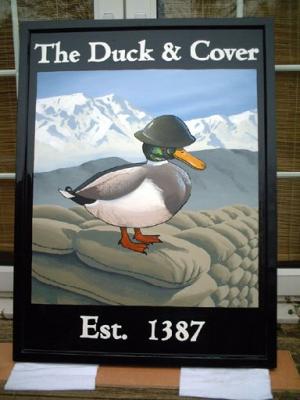
The executive summary is that Embassy Kabul looks good to very good. The main chancery is even architecturally sound (I'd include a picture but photography is strictly verboten), which isn't bad given that we're in a war zone. Compound life appeals to me: it's like college, where everyone's around all the time and there's always something going on if you know where you look. Only unlike college, there's a significantly larger amount of danger pay and I don't have to wait tables.
And all of that is good news, because I just accepted a handshake on a second year in Afghanistan, transferring from my post in the field to a position in the Public Affairs section in Kabul. I'm guessing that after a year in the middle of nowhere, surrounded by a thousand soldiers and an incredible amount of dust, a swimming pool and a couple hundred like-minded civilians will do me good.
Thursday, July 15, 2010
Transit
Dubai Airport and things are already a charlie foxtrot. I had checked my bag in Dulles all the way through to Kabul ("You can do that?" "We can do that. Trust us."), but Safi Airlines indicated that in order to transfer the bag from United, they'd need the baggage claim number. I had been late for my flight -- it was pouring in DC and my cabbie stopped in traffic and informed me that he wasn't willing to go to Dulles, and I had to beg another cab for a ride, and arrived at the airport late. In the sprint from check in to gate via an intensely slow security line, I lost the baggage claim tag.
"You can't have checked the bag through to Kabul," Safi Airlines told me. "They don't do that." ("They said they DO do that!")
"We can't locate the bag without the claim ticket," they told me. "Go to the gate and see if you can find it in your bag. You can't talk to United here because they only run night flights, so they're closed until the evening. And you're late, so run."
I tried to run to the gate but got stopped at customs, waved to a separate office where an officer scanned my passport, type type typed something into his computer, stared at the screen, called over another officer, type type typed some more, keyed in my passport number again and again and again, stared at the screen, typed, stared, waited. I had done the same thing thousands of times to visa applicants in Islamabad and karma picked a hell of a time to come back and bite me in the tail. Ten minutes later, near frantic, I was stamped through and allowed to leave. I have no idea what the delay was.
I was flying on Safi International (the name is derived from the word "saaf" and roughly means "cleanliness") and our flight was delayed at least an hour. This was great news, since it gave me a window to locate the baggage claim number. I called United in the UAE; they routed me to the airport baggage desk. "Have you filed a report for your lost bag?" baggage asked. "I just need the tag number," I said; "The bag isn't lost. Yet." "Ok," they replied. "Do you have the tag number? We can't file a report without the tag number."
I tried again and was transferred to India. "Cargo services; what is the nature of the material you'd like to ship?" Try again. "Reservations. Do you have an existing itinerary?" Panting in panic. God only knows what these phone calls cost me, on my US cell phone, roaming on Dubai telecom.
Finally I got through to baggage in the US (via a call center in India), who gave me the number, which I gave to a sparkling gate agent named Sama who was lovely and helpful and with whom I fell instantly in love. "Check back at noon before boarding," she told me. "I'll know then if we've located the bag." I did; they had: everything was ok.
I struck up a conversation with another guy at the airport and found out he was a contractor working in aviation out of Kabul airport. I ran into another colleague -- a USAID guy whom I'd met in Indiana -- and we started talking. The aviator asked what we do and I muttered State and the AID guy said AID, and then all of the training I'd had about loose lips sinking ships kicked in and I got started to get panicky that maybe we should just stop talking because god only knows who's listening. This is the paranoid schizophrenia that State wants us to have, and it was by god driven into me. They kept talking and I couldn't handle it (DID YOU LEARN NOTHING?), and so I put on my iPod so I couldn't answer more questions.
Safi Airlines. I was crammed into seat 24 Bravo; back of the bus, middle seat, sandwiched between two enormous gentlemen.
This is the profile I observed of people traveling to Kabul: heavily American (based on the accent of overheard English) with an added dash of Arabs (guttural Arabic) and only a few Afghans (more Pashto than Dari overheard); amongst the Americans, an almost equal split between white and black; significantly more male than female; stocky to muscular with little in the way of a neck; heavily tattooed. One guy wore a shirt proclaiming When I die, I'm going to heaven. I've done my time in HELL: Konduz, Afghanistan. The "hell" was in flaming block letters; I felt less conspicuous in my jeans and polo shirt.
Tuckered out from my fight for my baggage, I fell asleep immediately. They woke me up for the in flight meal (beef with rice and vegetables, side of mango pudding, definitely not bad), and I fell back asleep until near landing. I woke up as we were starting our initial approach over desolate, red dust mountains and low-slung houses in valleys. Either it was hazy or there was a dust storm, but visibility was limited. We approached, came in for a landing, and then pulled up hard for a second go around, denied landing permission by the tower. We came back ten minutes later, landed hard, bounced twice, and then taxied to the gate.
Welcome to Afghanistan.
"You can't have checked the bag through to Kabul," Safi Airlines told me. "They don't do that." ("They said they DO do that!")
"We can't locate the bag without the claim ticket," they told me. "Go to the gate and see if you can find it in your bag. You can't talk to United here because they only run night flights, so they're closed until the evening. And you're late, so run."
I tried to run to the gate but got stopped at customs, waved to a separate office where an officer scanned my passport, type type typed something into his computer, stared at the screen, called over another officer, type type typed some more, keyed in my passport number again and again and again, stared at the screen, typed, stared, waited. I had done the same thing thousands of times to visa applicants in Islamabad and karma picked a hell of a time to come back and bite me in the tail. Ten minutes later, near frantic, I was stamped through and allowed to leave. I have no idea what the delay was.
I was flying on Safi International (the name is derived from the word "saaf" and roughly means "cleanliness") and our flight was delayed at least an hour. This was great news, since it gave me a window to locate the baggage claim number. I called United in the UAE; they routed me to the airport baggage desk. "Have you filed a report for your lost bag?" baggage asked. "I just need the tag number," I said; "The bag isn't lost. Yet." "Ok," they replied. "Do you have the tag number? We can't file a report without the tag number."
I tried again and was transferred to India. "Cargo services; what is the nature of the material you'd like to ship?" Try again. "Reservations. Do you have an existing itinerary?" Panting in panic. God only knows what these phone calls cost me, on my US cell phone, roaming on Dubai telecom.
Finally I got through to baggage in the US (via a call center in India), who gave me the number, which I gave to a sparkling gate agent named Sama who was lovely and helpful and with whom I fell instantly in love. "Check back at noon before boarding," she told me. "I'll know then if we've located the bag." I did; they had: everything was ok.
I struck up a conversation with another guy at the airport and found out he was a contractor working in aviation out of Kabul airport. I ran into another colleague -- a USAID guy whom I'd met in Indiana -- and we started talking. The aviator asked what we do and I muttered State and the AID guy said AID, and then all of the training I'd had about loose lips sinking ships kicked in and I got started to get panicky that maybe we should just stop talking because god only knows who's listening. This is the paranoid schizophrenia that State wants us to have, and it was by god driven into me. They kept talking and I couldn't handle it (DID YOU LEARN NOTHING?), and so I put on my iPod so I couldn't answer more questions.
Safi Airlines. I was crammed into seat 24 Bravo; back of the bus, middle seat, sandwiched between two enormous gentlemen.
This is the profile I observed of people traveling to Kabul: heavily American (based on the accent of overheard English) with an added dash of Arabs (guttural Arabic) and only a few Afghans (more Pashto than Dari overheard); amongst the Americans, an almost equal split between white and black; significantly more male than female; stocky to muscular with little in the way of a neck; heavily tattooed. One guy wore a shirt proclaiming When I die, I'm going to heaven. I've done my time in HELL: Konduz, Afghanistan. The "hell" was in flaming block letters; I felt less conspicuous in my jeans and polo shirt.
Tuckered out from my fight for my baggage, I fell asleep immediately. They woke me up for the in flight meal (beef with rice and vegetables, side of mango pudding, definitely not bad), and I fell back asleep until near landing. I woke up as we were starting our initial approach over desolate, red dust mountains and low-slung houses in valleys. Either it was hazy or there was a dust storm, but visibility was limited. We approached, came in for a landing, and then pulled up hard for a second go around, denied landing permission by the tower. We came back ten minutes later, landed hard, bounced twice, and then taxied to the gate.
Welcome to Afghanistan.
Subscribe to:
Posts (Atom)

