Showing posts with label General Panic. Show all posts

Sunday, October 9, 2011

Kabul is a Different Universe.

I.

There was a huge thunderstorm on Thursday night. At around midnight, lightning actually struck the main building of the Embassy, and the resulting flash and concurrent roll of thunder was loud enough that the Marine on duty thought we were taking incoming and hit the duck and cover alarm.

I was long since in bed by that point but the thunder had woken me up, and I dutifully followed the instructions posted on the back of the door:

"If in hooch, stay there!

Get under your bed!"


So I rolled on to the floor of the converted shipping container I call home and skittered under the bed. But the hooch I'm in is a temporary unit, meant to tide me over until enough people have cycled out of Kabul that I can get a permanent shipping container to call my own. And since I'm just there temporarily, I haven't bothered to clean the place since I arrived.

It's been three weeks since I moved in and my hooch is filthy, a fact underscored by the ocean of unidentifiable crunchy bits that stuck to my body when I rolled under the bed. And it's firmly autumn in Kabul, so the floor was freezing in addition to being unpleasantly hard.

The duck and cover alarm stopped and I crawled back into bed, but ten seconds later the Marine came over the loudspeaker (referred to, in the MilSpeak lingua franca of Embassy Kabul, as the Big Voice) and told us to continue ducking and covering. I rolled back under the bed, but wisely took my blanket, tacoing myself inside of it against both the cold and the crunchy things on the floor.  The all-clear sounded 15 minutes later.

The next morning, I ordered a yoga mat to keep under the bed: I want something soft to lay on should meteorological phenomena -- or incoming fire -- make us take cover again in the future.

I still haven't cleaned, though.

II.

The Embassy was closed today for Columbus Day. Holidays were not a luxury we indulged in at the PRT, and I guiltily slept in until almost 7. I didn't make it to the gym until after 8, some four hours after my regular time.

There were a fistful of other people there when I arrived. One of them was staring down at the gym's gun-metal grey dumbbells, a prison-esque collection of chipped and rusty iron bars laid out in disorganized rows in front of the cracked wall mirror.  While I was futzing around with the bench press, the gentleman in question was strapping his head into a skull cap apparatus that had metal chains coming down the sides of it, terminating in a metal holster somewhere below his chin.  It toed the line between neo-electroshock therapy chic and, courtesy of the chains, something you might see at a heavy metal concert.

He hoisted one of the gun-metal colored dumbbells into the holster and began a series of head raises that seemed to be aimed strengthening his neck.

"There's something about this place that makes people act in ways that they would never act at home," one of my female colleagues had told me on Thursday. She was talking about the licentious atmosphere at the on-compound bar, where the primarily married but geographically single clientele are often overly forward in their drunken advances towards the very few females on compound.

The gym at 8 a.m. on a holiday is not the same as the compound's bar at midnight on a weekend, but as I watched a fellow gym goer sling around a dumbbell in a traction harness using only his neck, I couldn't help but think that she's maybe she's right.

III.

On Friday, I went to play frisbee on the helicopter landing zone at the military base adjacent to the Embassy.  The HLZ is actually just a large empty field, and on Fridays (the Islamic weekend and our one day off), it hosts a bazaar and a series of sporting events throughout the day.

Few people turned out for frisbee, and I ended up just tossing the disc around with a friend from Pol-Mil (J. Fundraiser, who currently runs humanitarian demining programs but once ran Obama's campaign in the state of Idaho) and a couple of Afghan kids from the bazaar. They were both maybe 12 years old.

We were eventually joined by a trio of military guys -- a Polish soldier and two Americans, one of whom was an enormous and solidly-built full bird Colonel who easily weighed over two hundred pounds -- probably closer to 220 or 230.  With seven players, we started up a makeshift game of ultimate.

At one point, I threw the disc down the field to one of the Afghan kids, and he and the full bird both charged hard for it. They jumped and collided and ended up collapsing in a heap near the end zone, with all two hundred and thirty or so pounds of Colonel falling directly on top of the Afghan kid.

The Colonel dusted himself off and got up, but the Afghan kid continued to lay crumpled on the ground, crying and clutching the shoulder that had just been crushed by a guy who was twice as big as him.  I tried to check him out to see if his collarbone was broken from the fall, but he wouldn't let me touch him, and after waiting a bit to see if he'd shake it off, I asked the other kids if his father was around in the bazaar.

Someone ran to get him, and shortly thereafter the father appeared on the other side of the field and began making his way over to us. He was an amputee -- one leg cut off below the knee -- and was using the kind of crutches that have loops you can put your wrists through.  He eventually made it to the side of the boy (still clutching his shoulder and crying) and poked at him with his crutch.  He growled in gravelly Dari: "WHAT did you do?"

One of the other boys tried to respond for him -- "we were playing a game..." -- but the father cut him off. "Crying like a WOMAN! You are bringing shame on your family and tribe!" And then he slammed him in the head with his crutch.  He went in for a second hit, but Fundraiser grabbed the bottom of the crutch as we both tried to calm him down. Intervention seemed like the right approach, but it was hardly a long-term solution since it's not like you can take the crutch away from the amputee, even if he's using it to beat his kid.

By that point, the kid had managed to get to his feet and was limping across the field, still holding his shoulder and crying for all he was worth. His father hobbled after him at a surprisingly fast clip, continuing to shout at him.  Fundraiser and I watched them both run off, feeling for all the world like our attempt to do the right thing was absolutely the wrong thing.

"I meant to tell you," one of the other boys said to us. "His father is kind of crazy."

Thursday, June 2, 2011

On Formatting, or "Things That Haunt Me"

I believe very strongly -- like, strongly enough to end relationships over it -- that sentences should end period space space. Period single space crushes me. I will hear no arguments about how we're no longer in a mono-space font universe and that period single space is the future: that's how animals end their sentences. Seriously, I've never seen a golden retriever hit the space bar twice after a period. Animals.

But I'm now back to blogging via blackberry (I bought one in Chiang Mai, which has the busiest English/Thai keyboard ever), emailing the posts to myself and blogger. Doing so totally destroys the formatting to begin with AND requires that I put the extra space in after each period manually, which is possibly the most annoying thing on earth.

So the burning question is: given the convenience of it, can I change to period single space without being too much of a hypocrite? That is, will the universe judge me harshly?

I have come to no final conclusion on this ethical dilemma question.

Friday, May 27, 2011

More Questions Than Answers.

I'm on R&R. Yes, again.

I felt pretty bad leaving again so soon after my last R&R, a feeling that the military seconded and that Commander Killjoy went out of his way to reinforce ("no one is forcing you to go on leave"). But guilty or otherwise, I think passing up 20 days of paid vacation out of some misguided sense of solidarnoszt with my military colleagues would be foolish. And I needed dental work, a fact I clung to defensively as I bought my plane tickets to Bangkok.

But the guilt has lingered, and Ive been working to make up for it. Mostly I'm getting things ready for my departure, organizing the things I need to pass on to my replacement and figuring out how to best do so. Looking back, it seems to me now that State did a terrible job of preparing us for this deployment, and I'm hoping to pass on enough information that the next crop of officers coming in -- probably not my replacement, but the group that follows her -- can hit the ground with a better sense of which way is up than I had when I landed in Farah.

As the ostensible "governance advisor" to the Province, there were things I should have known before my arrival but was never told and had never thought to look up -- I didn't know what questions to be asking, much less where to find the answers. They taught us Farsi, slapped "Governance Advsior" on our business cards, assured us we were experts and then shipped us off to rural Afghanistan without knowing a damn thing about the place. I spent my first few months waiting for someone in the military to call me out on it -- to shriek out that the Emperor has no clothes and to stop inviting me on missions outside the wire. I think we can do better.

There's an Afghan Area Studies course that goes along with language class -- I referred to it lovingly as "Rise and Fall of the Taliban Parts One Through Seventeen" -- but it was taught by an academic, not by a Foreign Service Officer, and was at best tangentially useful. It focused almost exclusively on the modern political history of Afghanistan, a topic that was often interesting but rarely useful. The course lasted a year and was followed by a completely worthless "Introduction to Provincial Reconstruction Teams," taught by a guy who had spent a year in Herat (a city that resembles nowhere else in Afghanistan), and who mostly just focused on his questionably legal business partnership with a Turkmen-owned dairy factory. ("You'll need to be an advocate for companies like these -- and you might end up a partner in the firm, like I did").

Meetings at the Embassy in advance of being shipped ot to the field were more useful, but Kabul is a busy place and the people we met with were understandably strapped for time. We spent a scant 45 minutes with the Embassy's expert on Provincial and District-level political structures, and it was the most useful 45 minutes of my entire training -- but 45 minutes is only enough time for a galloping overview, hardly enough to get one's feet wet. And I was in receive mode -- I again had no idea what questions I should be asking.

And so that's what I've been working on during this trip: I've been sitting at rickety Thai sidewalk cafe tables, sipping Tom Yum soup and fresh squeezed tangerine juice, and coming up with a comprehensive list of questions that people at the Embassy or back in Washington should be able to answer but that field officers on arrival can't -- unless the other field officers were somehow better prepped than me, which I will concede is a possibility.

What is the form and structure of the Provicnial Governor's Office? What is the assigned role of the Deputy Governor, the Provincial Executive Manager and the Administrative Manager? Who controls hiring for those positions, and how much latitude if any does the Governor have in firing them if necessary? Does the Governor's Office receive a budget beyond the U.S.-funded Performance Based Governor's Fund? If so, how much is said budget, what is the process for requesting it and how much latitude does the Governor have in executing it? What are the budgetary reporting requirements? Who compiles said reports, and with what frequency?

It gets pretty thick into the weeds of Afghan rural governance pretty quickly -- but this is the sort of information that field officers should have at their fingertips. To steal a phrase from the military -- we come in without knowing what right looks like.

What is the form and structure of the Provincial Director of Economy's office? What taxes is he legally allowed to collect, and are the revenues from said taxes returned to the Province, or sent directly to the Central Government? What are the obvious avenues for corruption, and what transparency measures if any are in place to prevent said corruption?

I'm not filling in the answers, though at this point I could answer almost all of the two pages worth of questions I've come up with so far. It took a full year of being knee-deep in the politics of Farah province, but at this point I would indeed consider myself an expert on Afghan sub-national governance. Most of my answers to these questions would start with "it is my understanding that...", but that's a facet of having garnered the information from Afghans themselves, and since the Afghan system of Government is obscenely complex (and designed, it seems, to keep power concentrated in the hands of a few), even they are frequently unsure of the answers.

But it's a start. When I finally finish, I'll pass the list of questions on to State's training center and give a copy to the Embassy so they can better prepare field officers who are coming through Kabul en route to their PRTs. I'll walk my replacement through them and make sure she knows at least as much as I do before I leave. I'm not under the impression that my year-long presence in Farah has in any way made a difference ("You need to be prepared to accept 'my province did not get worse' as a measure of success," we were told during one particularly pessimistic training class), but I can at least try to set up future officers for success.

Sunday, March 6, 2011

Law and Order: Farah Edition

The military's got a thing for Task Forces. My small base alone hosts four of them, and even after eight months here, I only kind of know what they're each tasked with. There's task force Southeast (which works roughly southeast of here), Task Force South (which confusingly doesn't work south of here -- that's the no-man's-land of Nimroz Province), Task Force 45 (God only knows), and Task Force Arrow ("Straight Arrows!"), which took over for Task Force Fury ("Fury from the Sky!") and which disappointingly is an infantry unit and uses neither crossbows nor other medieval weaponry, despite their name.

The sheer number of task forces in this country is equal parts overwhelming and ridiculous. A buddy of mine at a PRT in the East got fed up with it and declared himself and his fellow civilians to be Task Force Mongoose, allowing him to say things like, "uh, why wasn't Task Force Mongoose invited to this meeting?" We at PRT Farah have yet to declare ourselves to be a Task Force, but now that I think about it, that probably needs to happen.

Last week, PRT Farah hosted Combined Joint Task Force 435 -- CJIATF 435, if you will -- which is is tasked with overseeing detentions in Afghanistan (they took over for Task Force 82, according to their wikipedia page, and do you see how this Task Force thing is out of control?), and is headed by Admiral Harward, a three-star out of Kabul.

Here's the thing: two or three weeks ago or so, I was up in Herat hobnobbing with the good people from an entirely different and unrelated Task Force named Task Force Shafafiyat, who also sometimes go by the English translation of their name, "Task Force Transparency." (Irrelevant sidenote: I myself would romanize the word transparency as "shifafiyat," with an i and not a in the first syllable, but I was gently corrected by Kabul on the spelling and now have to choose between the Embassy-preferred but clearly incorrect spelling, or buck the trend and go with what I know to be correct and by extension have others think that I'm wrong; I have devoted more time to this dilemma than you would think humanly possible).

TF Shafafiyat, as you might guess, focuses on government transparency, and is headed by General H.R. McMaster, a charismatic and outspoken one-star with a shaved head and a forceful personality. He was intensely engaging and he was memorable, and that's not something I say lightly given the number of painfully forgettable PowerPoint presentations I've had to sit through during this war. (The now-famous spaghetti-as-war-diagram chart shown to McChrystal was not a random outlier; "this war will be won through better and more complex powerpoint slides," I've heard said sarcastically).

I have an obscenely bad memory for names and faces, but McMaster's strong presentation coupled with his appearance (wiry, muscular frame and shaved head) stuck in my mind. I was consequently quite surprised when Admiral Harward, the three star from CJIATF 435, stepped off of his C-130 at Farah Airfield and turned out to be identical to McMaster.


Seriously, look me in the eye and tell me they aren't identical.


So General McMaster Admiral Harwood and the rest of TF 435 showed up to come to Farah to talk about rule of law, the physical infrastructure of Farah prison and other related topics. They had come in part because of a report that was written about Farah's general Rule of Law conditions, and I had contacted the Embassy in a huff to ask for a copy, annoyed that someone was writing about my beloved province without having the courtesy to run it by me first. The Embassy responded, attaching the report to a quizzical email that gently noted that I had in fact written the report in question, in late November. And even though it was certainly mine -- I recognize my own sentence structure, even in dry reporting cables -- I to this day have no recollection of having typed it out.

So TF 435 showed up and was whisked up to our conference room for a discussion on rule of law. I had prepped myself by studying the report I had supposedly written (I considered sending myself a kudos on its comprehensiveness), and the meeting went fine. In reality, though, it was just a warm up for the big field trip of the day, which involved taking the Admiral to the Farah prison, both to see the facility itself and to take a gander at the $985,000 extension that the PRT is funding to ease overcrowding.

Farah prison was the site of one of the largest jailbreaks in Afghan history, which happened just before I arrived in July of last year. Some 20 Taliban members bribed the guards to smuggle in explosives, blew the doors off their cells and escaped into the rugged districts of Northern Farah; other Taliban members had staged simultaneous attacks on police checkpoints to draw the police away and provide cover for the escapees. Visiting the Prison had been on my to-do list for some time, though other things always seemed to crop up when the PRT's rule of law guy (First Sergeant McGruff, a 30-year veteran of the Michigan police department with a gruff, no-nonsense bearing) was headed that way, and I was excited that the Admiral had finally given me an excuse to get there.

We hadn't told the warden or anyone else that we were coming until the morning of the visit, so when we showed up an hour after phoning them, we were quite surprised to learn that they had arranged a ceremonial brick laying for us on the site of the extension, with a few cinder blocks written in ribbon and ready to be layed down. (I went back to the prison a few days after the visit on other business, and saw that rather than cutting off the ribbon, the Afghan contracting company had just cemented them into place as they stood, ribbons and bows still festively intact).

The Admiral had arrived in advance of the Godfather and I, and we hustled to catch up; he was already inside the prison when we approached the gate. "You can't go inside," the guard told us. "There's some Admiral in there."

"Right," I responded, pointing to the haf-dozen military people with me. "He's ours. We're with him. We need to get inside."

"You can go inside later. There's some admiral in there now," he responded. My translator took over and explained the situation in hurried Pashto, and the guard glowered at us suspiciously but ultimately acquiesced. "No weapons inside," he told us. The Godfather had a pistol on him and stayed behind; I and the other visiting military headed in.

Heading in required crawling through a 3-foot high door made of rusty iron and secured with enormous bolt locks. The door and the crawl space after it were low enough that you had to go on hands and knees, and the final entrance to the prison was another metal door with a similar fastening schema. The walls on the other side, in the center of the prison courtyard, were 20 feet high and made of smooth concrete; when the door slammed shut behind you, that was it: if they didn't want to let you leave, there was no way of getting out.

I felt like I was in the Shawshank Redemption. It was kind of terrifying.

("If a riot breaks out, hit the deck before they start shooting and stay still till you think it's over," McGruff had told me. "It's a god damn kill box in there, and the Afghan guards on the wall aren't going to differentiate between you and them.")

I had assumed that there would be no riots while we there, that the Admiral would take a brief tour of the facilities and then we would bolt. But he had come with his Afghan counterpart, the national-level Minister of Justice, and when I came in, the Minister was addressing the crowd of detainees in fast Persian; from what I could pick out, it sounded like he was berating the detainees ("you are here because you deserve to be here"), and the crowd was not responding well, shouting at the Minister in Pashto and generally looking rowdy.

I've said before that my fight-or-flight response is keyed squarely to flight, and the whole thing left me with a rising sense of panic and an ongoing, head-turning and slightly desperate search for an exit; my instinct was to inch towards the door, but that seemed futile given the 20-foot walls ringed with armed guards. There was, in short, no avenue of escape. The whole scene -- dusty tents in the courtyard flanked by rows of drying prison laundry, and nothing but to look at but motivational slogans and a small patch of empty blue sky -- seemed to designed to eradicate hope.

"Can you even begin to wrap your mind around how much misery there is in this place?" one of the Admiral's aides asked me. "I really can't," I told him.

The Minister finished speaking, took a few questions ("I am an innocent man, and everyone knows it; why am I here?" and then more heartwrendingly, "I was told that I would be released when I turned 70. I'm 72 now; when will I be released?"), and then we high-tailed it out.

The Governor told us later that he thought it foolhardy that we entered into the center of the prison with so many obscenely dangerous criminals wandering around. Commander Killjoy later mandated that no U.S. personnel are allowed to enter the inner courtyard in the future ("It really is a kill box in there"), making our visit possibly the last by USG representatives. All things considered, I can't say I'm sad I don't have to go back.

Friday, October 1, 2010

Chariots of Fire

Herat is a self-drive city, and I spent the five days of last week's conference being driven around by an amiable but high strung development advisor who's directly embedded with a military maneuver unit. He's got a Peace Corps gone rogue type demeanor, and he had the habit of referring to the military only as GI Joes: "I'm sharing a bathroom with 80 GI Joes," he said. "How many GI Joes you got sharing your bathroom?"

RoguePeaceCorps's style of driving toed the line between aggressive and manic, and he punctuated wild turns of the wheel ("you see how off this alignment is?") with long strings of full-throated but unconventional invective, directed mostly at pedestrians and stray dogs that tried to cross the street. "Shitdog! These kids have a death wish! Son of a … bastard!"

Self-drive is liberating, but there are upsides to riding in steel-plated convoys driven by well-armed Guamanians. Chief amongst them are that we don't get lost (we roll with a fancy GPS system and have a direct link back to an operations center) and we don't deal with checkpoints, since it would take a lot of bravery and some pretty heavy artillery to even attempt to stop a Cougar.

Because we don't deal with checkpoints, I have no idea how they work. It was clear in Herat that there's a system, but it was opaque to me -- sometimes we would dart around the traffic that was waiting at the checkpoints, and at other times we'd stop and wait. Checkpoints are universally acknowledged to be the most dangerous places in Afghanistan, and I found it nerve wracking. RoguePeaceCorps, with his predilection for aggressive driving (at times it seemed like he was using both pedals simultaneously, so erratic was his starting and stopping), didn't help things.

On the first day of the conference, we got stopped at an Italian military checkpoint just as the sun was setting, in between the conference site and the base where we were staying. There was a line of heavy trucks to our right, and we pulled into the oncoming traffic lane to pass them when we hit the seemingly impromptu checkpoint. We were waved to a halt by an Italian soldier in front of an armored humvee, its gun turret pointed in our direction. The Italians, RoguePeaceCorps told us, are known for being quick on the trigger, and he was nervous. "They shoot, man, they just shoot -- but we're sure as fuck not staying here till it gets dark," he said. A tiny Afghan car behind us, carrying far more passengers than the vehicle was intended for, tried to swing out onto a dirt track to beat a wide path around the Italians. They too were flagged to a halt. They put their car in reverse and inched back towards the road, but again got a signal to stop.

RoguePeaceCorps was muttering "this is not good, not good" to himself. He called one of the Operations Centers in Herat, but they weren't tracking any checkpoints. He called the Security Officer for Consulate Herat and was told the same thing. It was unclear if the Italians could see the diplomatic license plate strapped to the back of the sun visor on the passenger side, and equally unclear if such things matter to them at all. RoguePeaceCorps kept inching forward, and the Italians shined a high-powered flashlight in our direction to signal that he should stop. He pounded on the wheel. "What do you want me to DO?" he shouted.

"Those are dazzlers, right?" my USAID colleague from Farah asked me half-jokingly, half-nervously. "You know what comes next, right?" He was referring to the brief we have to sit through in Farah before every mission we go on; some slides never change, and the Rules of Engagement slide is one of them:

You have the inherent right of self defense. You must have positive identification before firing. Do not fire on historical sites or lines of communication. Escalation of force: Step One -- warning. Hand and arm signals. Step two: enhanced warning. Dazzlers.

The Italians were at step two, using dazzlers, and that put us only one step away from step three:

Step Three: Lethal Force. Shoot to disable, shoot to kill.

There's a feeling of helplessness in all of this that's hard to communicate. You're staring at a gun turret being manned by a military force that's considered quick on the trigger, and they appear to have escalated their warnings up to just shy of using lethal force; the driver isn't sure what to do, the sun is setting and everyone's on edge, and meanwhile you're stuck in the back seat while someone else has their foot on the gas pedal. You can't poke your head out the window and ask what you're supposed to do, because the windows don't go down on armored cars and even if they did, putting your head out of the armor and into the line of fire feels like it would be suicidal. You're pretty sure that you'd have ground the car to a halt by this point, but it's still inching forward and you don't have your foot on the gas pedal.

They hit us with the dazzlers again, and RoguePeaceCorps hit the brakes definitively. My heart was pounding. The Italians seemed to be waving us off the road onto the dirt path the local car had tried to take earlier. "I think they want you to go around," someone said. "Through fucking IED land over there? No fucking WAY, man!" RoguePeaceCorps responded. The local car that had tried to veer off earlier cut through the brush. We stared at the Italians, and they continued waving their hands and signaling with the dazzlers that we should be moving. Not moving seemed as bad as moving. My heart was still pounding.

We waited a few minutes more, and cars from the other side of the checkpoint that has also been directed around started arriving at our side. "If they made it without blowing up, we should be ok," RoguePeaceCorps said. We pulled off and eased our way through the scrub. We passed by the checkpoint and saw that the humvee blocking traffic had indeed had a 240-Bravo with its muzzle pointed directly at where our car had been stopped. It was guarding an Italian truck that had broken down and was stopped with the hood popped open. We made it back onto paved road and sped back to base, arriving before sunset.

Journalists have accused US forces of seeing the war through the periscope of armored vehicles, fully unaware of ground truths because we are unwilling to put ourselves on the streets without a significant protective layer. People in Herat say that being in a self-drive city is liberating, with the freedom to go wherever they want or need at any time without the advance notice required to scramble a convoy. I can see where both of them are coming from, but at the end of the day I have no complaints about having a military escort and an inch of steel between me and the outside world.

Tuesday, September 7, 2010

As far as call signs go, it could be worse.

I'm behind on blogging. I've been running ragged for the past few days, ankle deep in meetings and reports, and traveling a considerable amount both inside and outside the province. There's a lot to write about, but there's also a lot that can't be said on the blog; hopefully I'll catch up over Eid.

Eid -- that is, Eid-ul-Fitr, literally "the celebration of the breaking of fast" -- is the three-day holiday that's coming up roughly this weekend, to mark the end of the holy month of Ramadan. Muslims spend the month abstaining from food, drink and tobacco from sunrise to sunset, and it's always a difficult month, even if you're not fasting. Work days are generally cut in half for most Afghans, making it hard to get things done, and you can't help but feel bad for people sweltering during the long summer days without even water to drink. There's an oblique sense of guilt that accompanies having lunch or slugging back a surreptitious diet soda, even if it's only done in the privacy of the compound where few Afghan eyes can see.

We held an Iftar last night, the traditional celebratory meal eaten at the end of a day of fasting during Ramadan. It was a huge event -- a dinner for over 50 Afghans, held outside on rented carpets intended for weddings. We catered Afghan food (cinnamon-spiked basmati rice, whole roasted chickens, a side of meatballs and Afghan flatbread), and supplemented it with food from the chow hall that we know our Afghan counterparts enjoy but rarely get -- beef stew, fish in a lemon-butter sauce, chicken fingers, and a side of sweet corn.

About half the guests, just after breaking the fast. People were still arriving as the sun set, and most of the Americans were still outside greeting people.


It was a beautiful event, made more so by a lucky streak of perfect weather -- no driving dust or sandstorms, just a light breeze and relatively cool temperatures. It took the entire team to put it on -- security ringing the perimeter, and everyone else pitching in to do whatever needed done -- helping set the "tables" (carpets on the ground, covered in traditional Afghan eating cloths called dastarkhuan), or plate rice and meatballs, or lay out sodas. I was a little panicky about the entire event, and my constantly calling audibles left Sergeant Charlie (a Vietnamese-American who labeled the fridge in the Civil-Military Operations Center with a sign that reads "replace the water you take: Charlie is watching you") referring to me as "Bridezilla."

I will concede that I was picky on things like soda distribution -- I wanted them all in a cooler, not set out at individual places; who can know if our guests want an orange or a strawberry flavored Fanta, or a regular pepsi or a diet? I also had a lot to say about the placement of table cloths and the distribution of rice and fish and chicken fingers; the person tapped to be in charge of food, a Navy culinary specialist with a degree from Johnson and Wales (Petty Officer Frying Pan, if you will, although I'm reserving the right to change that nickname at a later point in time) was thrilled with my micromanagement, let me tell you.

Regardless, Bridezilla will stand by many of his requests: "can you move the MRAP so it blocks that broken down car up on blocks right in front of the entrance?" and "can that Air Force girl ditch her M-16 somewhere before the Afghans get here?" hardly seem unreasonable to me.

The Commander of the PRT (El Comandante, if you will), greeting an Afghan entering the FOB.

Thursday, August 26, 2010

Pie in the Sky

The weather in Farah since my arrival has been blue skies and hot wind, with the relative clarity of the day depending on how much dust the wind kicks up. Everyone has commented on how cool it's been relative to before my arrival, with temperatures in the 100s but never topping 110 and only one day that was so truly brutally scorching that it felt like the earth had moved closer to the sun.

We've been hit by a series of sandstorms over the past few days, with wind whipping through the valley and driving fine sand into your eyes, the dust blotting out the mountains in the background. It's still hot, but the sun feels dimmer in the mornings. Flights have been grounded, and you can't help but feel constantly unclean from the layer of grit that accumulates in your hair over the course of the day.

It's been about a month since I've seen clouds. There are, on very rare mornings, a few wisps of cirrus off in the distance above the mountains, but for the most part the sky is an empty blue. There's just not enough moisture.

This morning the sky was completely clouded over with ominous grey storm clouds, the first I've seen in a month. It actually made me a little panicky, and I thought about going back to the barracks and waiting it out -- like clouds were enough that work would be cancelled due to inclement weather. "It looks like it's going to rain," I said to my coworkers. "It won't," they replied. "It already rained this year, and you missed it."

Friday, July 16, 2010

Arrival in Kabul

With the exception of immigration officers, no one working at Kabul International wears a uniform -- not even a name badge. This makes it hard to know if the person in jeans and a sporty striped shirt demanding information actually needs to know where you work or if he's just shady and wants to know. Likewise, the guys pushing carts and trying to help you with your bags -- they could be freelancers looking to make a couple Afghani, or they could be airport provided, or they could be someone else: unclear. There was a pack of foreigners -- 90 percent of the plane, it seemed -- trying to fill out the supposedly mandatory registration forms. Guys who might've been working (without uniforms in a chaotic environment, it's surprisingly hard to tell who's a worker and who's a hustler) asked where I worked, and when I whispered US Embassy, they waved me forward: no forms required.

My bag, an enormous military duffel that's far too large and will have to be scaled down, miraculously arrived. The guy from USAID's bags arrived as well and I was glad he was there: two Embassy people meant double the chance of a ride actually showing up. We grabbed rickety carts (the right wheel of mine was ellipse shaped and rolled like an egg going end-over-end) and pushed through, and a guy just beyond baggage claim was there holding an American flag sign. It turned out I had nothing to worry about: the Arrivals and Departures Unit at the embassy is massively organized, and unbeknownst to me I was one of something like 8 people arriving on that flight.

They led us to cars, past a large sign reading "NO WEAPONS" with a Kalashnikov with a crossed red circle over it. In the parking lot there were large police cars mounted with huge UN-style antennas that arc from the back the front bumper, where they're tied down when not in use, and the sides of the cars were stenciled in Dari with Poliis dar hidmat-e-mardum, "Police in Service of the People." Our drivers distributed body armor, triple checked that everyone was accounted for, and drove us into the city.

I was expecting Islamabad -- a sort of leafy green sleepiness with groups of men clustered around markets but the streets relatively empty and dotted with the odd donkey cart. Instead, it was Beijing: packed beyond any speaking of it. Cars were everywhere, veering down the wrong side of traffic, honking, pushing forward with little regard for traffic laws. Pedestrians were everywhere, seemingly with no regard for self preservation, leaping into traffic without looking and appearing to throw themselves in front of our cars. (A friend who works in Saudi told me that most Islamic head coverings eliminate peripheral vision for women, and I couldn't help but wonder if they could even see us coming). It was rush hour and the streets were packed with truly massive numbers of people milling around, almost what you'd expect to see outside of a stadium during a major sporting event in the States.

We passed checkpoints manned by guards carrying what appeared to be snub-nosed AK-47s. (The AK has a distinctively curved magazine that's significantly longer than those on the rifles that our guys carry, and that's what I'm going on; despite weapons familiarization, I know almost nothing about guns). It was hot and dusty on packed streets, and in an armored car wearing body armor I felt very conspicuous.

We arrived at the Embassy remarkably quickly and were met on arrival by representatives from Kabul/IPA/FSU -- that is, the bureau of Inter-Provincial Affairs/Field Support Unit. I was taken to my temporary housing (one of three beds in a surprisingly nice building; not the six-beds-in-a-hooch situation I was expecting). I took a deep breath, feeling like I'd made it: I was ok. I brushed my teeth in celebration.

They gave us cell phones ("consider this phone to be part of your uniform; carry it at all times") and had us fill out some paperwork -- standard Embassy forms acknowledging receipt of cell phone, requesting access to the computers, what have you. They gave us a quick tour of the compound, through the Embassy logo store (polos, t-shirts, keychains and other stuff emblazoned with the Embassy logo, as well as, somewhat inexplicably, a selection of locally grown vegetables). We swung through one of two cafeterias, where all food is free for the price of your initials. We passed the pool and volleyball court, and looked through the window at one of three gyms.

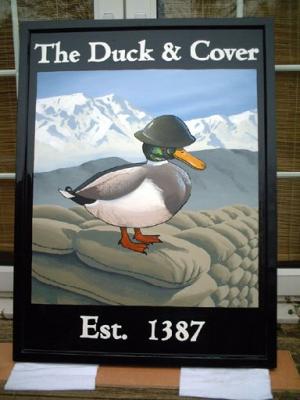
The USAID guy peeled off for a welcome dinner with other AID types, and I ate with the guy in charge of my in-processing -- surprisingly tasty chicken teriyaki, steamed vegetables, a pineapple juice box. I swung by the Marine guard to get my Embassy badge (different than a State badge, applicable only to Embassy Kabul) and then walked to the Embassy bar -- the Duck and Cover -- to meet a friend from training for a beer.


The executive summary is that Embassy Kabul looks good to very good. The main chancery is even architecturally sound (I'd include a picture but photography is strictly verboten), which isn't bad given that we're in a war zone. Compound life appeals to me: it's like college, where everyone's around all the time and there's always something going on if you know where you look. Only unlike college, there's a significantly larger amount of danger pay and I don't have to wait tables.

And all of that is good news, because I just accepted a handshake on a second year in Afghanistan, transferring from my post in the field to a position in the Public Affairs section in Kabul. I'm guessing that after a year in the middle of nowhere, surrounded by a thousand soldiers and an incredible amount of dust, a swimming pool and a couple hundred like-minded civilians will do me good.

Thursday, July 15, 2010

Transit

Dubai Airport and things are already a charlie foxtrot. I had checked my bag in Dulles all the way through to Kabul ("You can do that?" "We can do that. Trust us."), but Safi Airlines indicated that in order to transfer the bag from United, they'd need the baggage claim number. I had been late for my flight -- it was pouring in DC and my cabbie stopped in traffic and informed me that he wasn't willing to go to Dulles, and I had to beg another cab for a ride, and arrived at the airport late. In the sprint from check in to gate via an intensely slow security line, I lost the baggage claim tag.

"You can't have checked the bag through to Kabul," Safi Airlines told me. "They don't do that." ("They said they DO do that!")

"We can't locate the bag without the claim ticket," they told me. "Go to the gate and see if you can find it in your bag. You can't talk to United here because they only run night flights, so they're closed until the evening. And you're late, so run."

I tried to run to the gate but got stopped at customs, waved to a separate office where an officer scanned my passport, type type typed something into his computer, stared at the screen, called over another officer, type type typed some more, keyed in my passport number again and again and again, stared at the screen, typed, stared, waited. I had done the same thing thousands of times to visa applicants in Islamabad and karma picked a hell of a time to come back and bite me in the tail. Ten minutes later, near frantic, I was stamped through and allowed to leave. I have no idea what the delay was.

I was flying on Safi International (the name is derived from the word "saaf" and roughly means "cleanliness") and our flight was delayed at least an hour. This was great news, since it gave me a window to locate the baggage claim number. I called United in the UAE; they routed me to the airport baggage desk. "Have you filed a report for your lost bag?" baggage asked. "I just need the tag number," I said; "The bag isn't lost. Yet." "Ok," they replied. "Do you have the tag number? We can't file a report without the tag number."

I tried again and was transferred to India. "Cargo services; what is the nature of the material you'd like to ship?" Try again. "Reservations. Do you have an existing itinerary?" Panting in panic. God only knows what these phone calls cost me, on my US cell phone, roaming on Dubai telecom.

Finally I got through to baggage in the US (via a call center in India), who gave me the number, which I gave to a sparkling gate agent named Sama who was lovely and helpful and with whom I fell instantly in love. "Check back at noon before boarding," she told me. "I'll know then if we've located the bag." I did; they had: everything was ok.

I struck up a conversation with another guy at the airport and found out he was a contractor working in aviation out of Kabul airport. I ran into another colleague -- a USAID guy whom I'd met in Indiana -- and we started talking. The aviator asked what we do and I muttered State and the AID guy said AID, and then all of the training I'd had about loose lips sinking ships kicked in and I got started to get panicky that maybe we should just stop talking because god only knows who's listening. This is the paranoid schizophrenia that State wants us to have, and it was by god driven into me. They kept talking and I couldn't handle it (DID YOU LEARN NOTHING?), and so I put on my iPod so I couldn't answer more questions.

Safi Airlines. I was crammed into seat 24 Bravo; back of the bus, middle seat, sandwiched between two enormous gentlemen.

This is the profile I observed of people traveling to Kabul: heavily American (based on the accent of overheard English) with an added dash of Arabs (guttural Arabic) and only a few Afghans (more Pashto than Dari overheard); amongst the Americans, an almost equal split between white and black; significantly more male than female; stocky to muscular with little in the way of a neck; heavily tattooed. One guy wore a shirt proclaiming When I die, I'm going to heaven. I've done my time in HELL: Konduz, Afghanistan. The "hell" was in flaming block letters; I felt less conspicuous in my jeans and polo shirt.

Tuckered out from my fight for my baggage, I fell asleep immediately. They woke me up for the in flight meal (beef with rice and vegetables, side of mango pudding, definitely not bad), and I fell back asleep until near landing. I woke up as we were starting our initial approach over desolate, red dust mountains and low-slung houses in valleys. Either it was hazy or there was a dust storm, but visibility was limited. We approached, came in for a landing, and then pulled up hard for a second go around, denied landing permission by the tower. We came back ten minutes later, landed hard, bounced twice, and then taxied to the gate.

Welcome to Afghanistan.

Monday, July 12, 2010

Laying the Ground Work

T-minus 36 hours till I board the plane for Dubai, and I'm more or less hyperventilating at everything I still have to do: hit the pentagon to get the ID card that allows me to eat and shop on base; repack my bag so it's light enough to carry by myself; return my tags to the DMV and cancel my car insurance, as well as my cell phone plan and gym membership. And I need a haircut, and some dental work, and there are still goodbyes to be said.

The process of getting to Afghanistan is far more daunting than the idea of going to war. The paperwork is incredible, so much so that State has hired contractors to help streamline in-processing. There are checklists upon checklists. Things that seem like they go without saying must be specifically requested, and if all the boxes aren't checked, you'll be denied landing permission. Do you need transportation from the airport? Do you need housing upon arrival? Will you be collecting danger and hardship pay? Request them in writing or expect to be be denied.

My favorite piece of paperwork was the gym membership waiver, reminding those of us headed to a war zone that moderate physical exercise can result in injury and the Embassy is not responsible should things go pear shaped. This was on top of the form reminding employees that Afghanistan is a hardship tour and we should be prepared to wear a minimum of 30 pounds of armor and expect our housing to be sub par.

There were weeks of training. My 39 weeks of Dari, the Afghan dialect of Farsi, ended three weeks ago and I'm already slipping, despite spending all my time chattering to myself in broken phrases.

And then there was Indiana, an intensive intro to Afghan village life and working with the US military -- the ins and outs of protective details and how to be protected. It was taught at a mock Forward Operation Base (FOB) in rural Indiana, three hours from nowhere: FOB Panther, named for the local high school's mascot.

The scope of the training was incredible. Groups of 8 civilians, each coupled with one military and two civilian "subject matter experts" (SMEs -- "smees") who had just returned from working in the field in Afghanistan. Each group of civilians was being protected by a small contingent of 6-12 National Guardsmen who'd been called up to spend two weeks learning personal protection tactics, as well as how to deal with the somewhat persnickety animal that is a Federal Civilian.

("We should call this OEF-1," one of the Guardsman said in reference to us and playing off the acronym for Operation Enduring Freedom. "That stands for 'Over Educated Fucks.'")

The bridge between each group of civilians and their protective soldiers was a Sergeant, tasked primarily with training the soldiers but also with making sure the civilians know their role in the game of personal protection -- how to act, how to react, and how to be a help rather than a hindrance.

Our Sergeant was a Scottish immigrant who combined Hollywood-style drill sergeant gusto with a highland brogue. He had for a healthy contempt for civilians, and generally referred to us as "you lot" -- as in, "what YOU LOT forget is that if you ask these people what time it is, they'll tell you how to build a fucking watch!". Having been tasked with molding us into war-ready team members in a scant six days, he was determined to make the best of it even if he couldn't make us do pushups. He was, in short, awesome.

He spent a week berating us into being better protectees, lecturing us about how idiotic civilians always refuse to keep their helmets and body armor on (our military SME later conceded that it would be impossible to conduct a meeting with a helmet on). He drilled into us that if at any time he or another member of the security force barked out the code phrase "Bayonet! Bayonet! Bayonet!" (always three times, to be clear), that we should run for the door.

("If YOU LOT were put in charge of selecting the egress word, you'd probably pick something STUPID. Like 'lunchtime.' If I called out "lunchtime! lunchtime! lunchtime!" would any of you be running?" And then gesturing to a more heavyset member of our group, he added, "Well, except him?")

We practiced "downed driver drills," taking control of armored humvees from the backseat using a throttle control lever on the dashboard. We learned how soldiers communicate by the sounds of their guns -- that certain guns shot for certain periods of time signal a safe curtain in which you can bolt for the safety of the armored vehicle. We were in mock ambushes and mortar and IED attacks, simulated with fake grenades and light arms filled with blanks. I learned, in no uncertain terms, that I am the first to take cover. I confirmed that my fight-or-flight impulse is keyed squarely to flight, and that few people are faster than me. Lacking a gym, I spent my evenings running the perimeter of the base in body armor.

The military had purchased a former mental hospital, and littered the lawns with rubble and the charred, rusted carcasses of bombed out automobiles. Some of the buildings they detonated and some they sledgehammered to make them look old. They covered the walls in graffiti in Dari and Pashto: "Death to America, death to the Soviet Union. The Mujaheddin are the champions of the nation." They hired Afghans as role players, to act as translators and partners, adversaries and devils' advocates. It was as close to Afghanistan as you could be, though lacking mountains and with significantly more corn.

We practiced sitting at a table across from a group of people making demands: the clinic needs money for medicine. The roads are poorly paved and need resurfacing; promise that you'll do so. Your government must pay to refurbish this building; you built it two years ago but already it's falling apart. The point is to focus on the long term, emphasizing sustainability. If we refurbish the building, will it be falling apart again two years from now? What are your maintenance plans and who have you hired to implement them? What resources do you already have that you're not utilizing? There was enormous pressure to cave and promise resources that weren't ours to promise -- State promising USAID money or committing the military to something not within our purview. Our SMEs confirmed that we can expect more or less every meeting in Afghanistan to have an element of high pressure salesmanship to it.

We offered condolences to the family of someone mistakenly killed by a US airstrike. We met with the Governor, the Provincial Development Council, and leaders from civil society and NGOs. We visited a remote combat outpost and considered requests for the expansion of civilian personnel in the outlying districts. We rode a blackhawk, which filled me with a child-like sense of glee. It was like summer camp, only with a lingering sense of dread that we could be attacked at any moment. I have never felt more prepared for an upcoming assignment than I did following the training in Indiana.

And then came a few days in West Virginia, at a State-contracted raceway in the middle of nowhere. First was offensive driving training. How to stop at high speed, reverse at high speed, use your car to ram another car out of the way. How to generally be street aware and keep one's eyes peeled for potential insurgents, car bombs, IEDs, ambushes.

Did I crash the Crown Vic assigned to my group? Maybe. Maybe I lost control of the car while backing up at 40 miles an hour, and maybe I turned the wheel the wrong way and got a little panicky and maybe I slammed on the brakes (in contravention of everything they taught us) and maybe we had a little dust up with a concrete wall. And MAYBE the car stopped working after that and had to be towed off. The world may never know. (My colleague, taking a cue from me that speed kills, practiced escape by reversing at an outrageously slow pace. "Ah yes," I said, "here we are escaping from the terrorists at a nice, leisurely pace." Although by that point, I wasn't really in a position to be making fun of anyone).

Then came explosives familiarization: classes on the physics of explosions, the creation of blast waves and primary, secondary and tertiary dangers of explosions (which are, respectively, the blast itself, the shrapnel caused by the blast, and any impact a person may have with a ground or other objects when lifted by the blast wave). It was accompanied by video after video of things blowing up -- of car bombs and truck bombs and people dying. And then came a demonstration: low explosives and high explosives, det cord (high explosives contained in wire), a blasting cap, TATP (the liquid explosive that prevents one from taking a water bottle though airport security), and finally a lump of C4 about the size of half of bratwurst, stuffed into the ashtray of broken down Cadillac. "This demonstration," I told my colleague standing next to me, "has eradicated my desire to go to Afghanistan." "I was just thinking the same thing," he told me.

And finally weapons training. Three hours of classroom time taught by a firearms loving ex-marine. (My burning question: "With the exception of pulling the trigger, is there any way to make that gun go off?" The answer: an emphatic no). Then two magazines with five bullets each for five different guns; fifty rounds total. I started with a baretta, the service pistol carried by our troops. I waited in line, got to the front, and told the instructor that I'd never touched much less fired a gun and was skittish. He walked me through it: safety on, safety off; magazine in and out; hands here, second hand wraps around, grip tightly, aim through the sights and fire. He was extraordinarily patient. I think I hit the target once or twice.

Moved to the Glock and then on to one of two rifles -- the M4, carried by our soldiers. I repeated my spiel: first time touching a rifle, third gun ever shot, kind of skittish. "Pffft. My fifteen year old daughter can shoot this gun," the instructor sneered. "Ok, that's not helpful," I replied.

Then combat medicine: how combat medicine is different than civilian/EMT medicine (there's more focus on bleeding and hypothermia), how to tourniquet and pressure bandage to stop bleeding, how to treat puncture wounds to the chest to prevent lung collapse. "I know some of you are squeemish about seeing people bleeding," our medic instructor told us before putting on a video. "But this next video only LOOKS gruesome. It's fake. If you look closely you can tell that it's actually just a rump roast that they put into a pair of pants and are pumping fake blood through."

And that was that. Afghan prep: one glorious year, complete.

I finished writing this in the air over the Persian Gulf, off the northern coast of Saudi Arabia. I'm about half an hour from Dubai and less than a day from Afghanistan. I'm more nervous about simple logistics -- will there be anyone at the airport to pick me up? What will my room look like in Farah? Do I have too much stuff? -- than I am about being in Afghanistan. I feel well prepared. I also feel like I have no idea what I've gotten myself into.