Showing posts with label Chaos. Show all posts

Sunday, March 6, 2011

Law and Order: Farah Edition

The military's got a thing for Task Forces. My small base alone hosts four of them, and even after eight months here, I only kind of know what they're each tasked with. There's task force Southeast (which works roughly southeast of here), Task Force South (which confusingly doesn't work south of here -- that's the no-man's-land of Nimroz Province), Task Force 45 (God only knows), and Task Force Arrow ("Straight Arrows!"), which took over for Task Force Fury ("Fury from the Sky!") and which disappointingly is an infantry unit and uses neither crossbows nor other medieval weaponry, despite their name.

The sheer number of task forces in this country is equal parts overwhelming and ridiculous. A buddy of mine at a PRT in the East got fed up with it and declared himself and his fellow civilians to be Task Force Mongoose, allowing him to say things like, "uh, why wasn't Task Force Mongoose invited to this meeting?" We at PRT Farah have yet to declare ourselves to be a Task Force, but now that I think about it, that probably needs to happen.

Last week, PRT Farah hosted Combined Joint Task Force 435 -- CJIATF 435, if you will -- which is is tasked with overseeing detentions in Afghanistan (they took over for Task Force 82, according to their wikipedia page, and do you see how this Task Force thing is out of control?), and is headed by Admiral Harward, a three-star out of Kabul.

Here's the thing: two or three weeks ago or so, I was up in Herat hobnobbing with the good people from an entirely different and unrelated Task Force named Task Force Shafafiyat, who also sometimes go by the English translation of their name, "Task Force Transparency." (Irrelevant sidenote: I myself would romanize the word transparency as "shifafiyat," with an i and not a in the first syllable, but I was gently corrected by Kabul on the spelling and now have to choose between the Embassy-preferred but clearly incorrect spelling, or buck the trend and go with what I know to be correct and by extension have others think that I'm wrong; I have devoted more time to this dilemma than you would think humanly possible).

TF Shafafiyat, as you might guess, focuses on government transparency, and is headed by General H.R. McMaster, a charismatic and outspoken one-star with a shaved head and a forceful personality. He was intensely engaging and he was memorable, and that's not something I say lightly given the number of painfully forgettable PowerPoint presentations I've had to sit through during this war. (The now-famous spaghetti-as-war-diagram chart shown to McChrystal was not a random outlier; "this war will be won through better and more complex powerpoint slides," I've heard said sarcastically).

I have an obscenely bad memory for names and faces, but McMaster's strong presentation coupled with his appearance (wiry, muscular frame and shaved head) stuck in my mind. I was consequently quite surprised when Admiral Harward, the three star from CJIATF 435, stepped off of his C-130 at Farah Airfield and turned out to be identical to McMaster.


Seriously, look me in the eye and tell me they aren't identical.


So General McMaster Admiral Harwood and the rest of TF 435 showed up to come to Farah to talk about rule of law, the physical infrastructure of Farah prison and other related topics. They had come in part because of a report that was written about Farah's general Rule of Law conditions, and I had contacted the Embassy in a huff to ask for a copy, annoyed that someone was writing about my beloved province without having the courtesy to run it by me first. The Embassy responded, attaching the report to a quizzical email that gently noted that I had in fact written the report in question, in late November. And even though it was certainly mine -- I recognize my own sentence structure, even in dry reporting cables -- I to this day have no recollection of having typed it out.

So TF 435 showed up and was whisked up to our conference room for a discussion on rule of law. I had prepped myself by studying the report I had supposedly written (I considered sending myself a kudos on its comprehensiveness), and the meeting went fine. In reality, though, it was just a warm up for the big field trip of the day, which involved taking the Admiral to the Farah prison, both to see the facility itself and to take a gander at the $985,000 extension that the PRT is funding to ease overcrowding.

Farah prison was the site of one of the largest jailbreaks in Afghan history, which happened just before I arrived in July of last year. Some 20 Taliban members bribed the guards to smuggle in explosives, blew the doors off their cells and escaped into the rugged districts of Northern Farah; other Taliban members had staged simultaneous attacks on police checkpoints to draw the police away and provide cover for the escapees. Visiting the Prison had been on my to-do list for some time, though other things always seemed to crop up when the PRT's rule of law guy (First Sergeant McGruff, a 30-year veteran of the Michigan police department with a gruff, no-nonsense bearing) was headed that way, and I was excited that the Admiral had finally given me an excuse to get there.

We hadn't told the warden or anyone else that we were coming until the morning of the visit, so when we showed up an hour after phoning them, we were quite surprised to learn that they had arranged a ceremonial brick laying for us on the site of the extension, with a few cinder blocks written in ribbon and ready to be layed down. (I went back to the prison a few days after the visit on other business, and saw that rather than cutting off the ribbon, the Afghan contracting company had just cemented them into place as they stood, ribbons and bows still festively intact).

The Admiral had arrived in advance of the Godfather and I, and we hustled to catch up; he was already inside the prison when we approached the gate. "You can't go inside," the guard told us. "There's some Admiral in there."

"Right," I responded, pointing to the haf-dozen military people with me. "He's ours. We're with him. We need to get inside."

"You can go inside later. There's some admiral in there now," he responded. My translator took over and explained the situation in hurried Pashto, and the guard glowered at us suspiciously but ultimately acquiesced. "No weapons inside," he told us. The Godfather had a pistol on him and stayed behind; I and the other visiting military headed in.

Heading in required crawling through a 3-foot high door made of rusty iron and secured with enormous bolt locks. The door and the crawl space after it were low enough that you had to go on hands and knees, and the final entrance to the prison was another metal door with a similar fastening schema. The walls on the other side, in the center of the prison courtyard, were 20 feet high and made of smooth concrete; when the door slammed shut behind you, that was it: if they didn't want to let you leave, there was no way of getting out.

I felt like I was in the Shawshank Redemption. It was kind of terrifying.

("If a riot breaks out, hit the deck before they start shooting and stay still till you think it's over," McGruff had told me. "It's a god damn kill box in there, and the Afghan guards on the wall aren't going to differentiate between you and them.")

I had assumed that there would be no riots while we there, that the Admiral would take a brief tour of the facilities and then we would bolt. But he had come with his Afghan counterpart, the national-level Minister of Justice, and when I came in, the Minister was addressing the crowd of detainees in fast Persian; from what I could pick out, it sounded like he was berating the detainees ("you are here because you deserve to be here"), and the crowd was not responding well, shouting at the Minister in Pashto and generally looking rowdy.

I've said before that my fight-or-flight response is keyed squarely to flight, and the whole thing left me with a rising sense of panic and an ongoing, head-turning and slightly desperate search for an exit; my instinct was to inch towards the door, but that seemed futile given the 20-foot walls ringed with armed guards. There was, in short, no avenue of escape. The whole scene -- dusty tents in the courtyard flanked by rows of drying prison laundry, and nothing but to look at but motivational slogans and a small patch of empty blue sky -- seemed to designed to eradicate hope.

"Can you even begin to wrap your mind around how much misery there is in this place?" one of the Admiral's aides asked me. "I really can't," I told him.

The Minister finished speaking, took a few questions ("I am an innocent man, and everyone knows it; why am I here?" and then more heartwrendingly, "I was told that I would be released when I turned 70. I'm 72 now; when will I be released?"), and then we high-tailed it out.

The Governor told us later that he thought it foolhardy that we entered into the center of the prison with so many obscenely dangerous criminals wandering around. Commander Killjoy later mandated that no U.S. personnel are allowed to enter the inner courtyard in the future ("It really is a kill box in there"), making our visit possibly the last by USG representatives. All things considered, I can't say I'm sad I don't have to go back.

Friday, October 1, 2010

Chariots of Fire

Herat is a self-drive city, and I spent the five days of last week's conference being driven around by an amiable but high strung development advisor who's directly embedded with a military maneuver unit. He's got a Peace Corps gone rogue type demeanor, and he had the habit of referring to the military only as GI Joes: "I'm sharing a bathroom with 80 GI Joes," he said. "How many GI Joes you got sharing your bathroom?"

RoguePeaceCorps's style of driving toed the line between aggressive and manic, and he punctuated wild turns of the wheel ("you see how off this alignment is?") with long strings of full-throated but unconventional invective, directed mostly at pedestrians and stray dogs that tried to cross the street. "Shitdog! These kids have a death wish! Son of a … bastard!"

Self-drive is liberating, but there are upsides to riding in steel-plated convoys driven by well-armed Guamanians. Chief amongst them are that we don't get lost (we roll with a fancy GPS system and have a direct link back to an operations center) and we don't deal with checkpoints, since it would take a lot of bravery and some pretty heavy artillery to even attempt to stop a Cougar.

Because we don't deal with checkpoints, I have no idea how they work. It was clear in Herat that there's a system, but it was opaque to me -- sometimes we would dart around the traffic that was waiting at the checkpoints, and at other times we'd stop and wait. Checkpoints are universally acknowledged to be the most dangerous places in Afghanistan, and I found it nerve wracking. RoguePeaceCorps, with his predilection for aggressive driving (at times it seemed like he was using both pedals simultaneously, so erratic was his starting and stopping), didn't help things.

On the first day of the conference, we got stopped at an Italian military checkpoint just as the sun was setting, in between the conference site and the base where we were staying. There was a line of heavy trucks to our right, and we pulled into the oncoming traffic lane to pass them when we hit the seemingly impromptu checkpoint. We were waved to a halt by an Italian soldier in front of an armored humvee, its gun turret pointed in our direction. The Italians, RoguePeaceCorps told us, are known for being quick on the trigger, and he was nervous. "They shoot, man, they just shoot -- but we're sure as fuck not staying here till it gets dark," he said. A tiny Afghan car behind us, carrying far more passengers than the vehicle was intended for, tried to swing out onto a dirt track to beat a wide path around the Italians. They too were flagged to a halt. They put their car in reverse and inched back towards the road, but again got a signal to stop.

RoguePeaceCorps was muttering "this is not good, not good" to himself. He called one of the Operations Centers in Herat, but they weren't tracking any checkpoints. He called the Security Officer for Consulate Herat and was told the same thing. It was unclear if the Italians could see the diplomatic license plate strapped to the back of the sun visor on the passenger side, and equally unclear if such things matter to them at all. RoguePeaceCorps kept inching forward, and the Italians shined a high-powered flashlight in our direction to signal that he should stop. He pounded on the wheel. "What do you want me to DO?" he shouted.

"Those are dazzlers, right?" my USAID colleague from Farah asked me half-jokingly, half-nervously. "You know what comes next, right?" He was referring to the brief we have to sit through in Farah before every mission we go on; some slides never change, and the Rules of Engagement slide is one of them:

You have the inherent right of self defense. You must have positive identification before firing. Do not fire on historical sites or lines of communication. Escalation of force: Step One -- warning. Hand and arm signals. Step two: enhanced warning. Dazzlers.

The Italians were at step two, using dazzlers, and that put us only one step away from step three:

Step Three: Lethal Force. Shoot to disable, shoot to kill.

There's a feeling of helplessness in all of this that's hard to communicate. You're staring at a gun turret being manned by a military force that's considered quick on the trigger, and they appear to have escalated their warnings up to just shy of using lethal force; the driver isn't sure what to do, the sun is setting and everyone's on edge, and meanwhile you're stuck in the back seat while someone else has their foot on the gas pedal. You can't poke your head out the window and ask what you're supposed to do, because the windows don't go down on armored cars and even if they did, putting your head out of the armor and into the line of fire feels like it would be suicidal. You're pretty sure that you'd have ground the car to a halt by this point, but it's still inching forward and you don't have your foot on the gas pedal.

They hit us with the dazzlers again, and RoguePeaceCorps hit the brakes definitively. My heart was pounding. The Italians seemed to be waving us off the road onto the dirt path the local car had tried to take earlier. "I think they want you to go around," someone said. "Through fucking IED land over there? No fucking WAY, man!" RoguePeaceCorps responded. The local car that had tried to veer off earlier cut through the brush. We stared at the Italians, and they continued waving their hands and signaling with the dazzlers that we should be moving. Not moving seemed as bad as moving. My heart was still pounding.

We waited a few minutes more, and cars from the other side of the checkpoint that has also been directed around started arriving at our side. "If they made it without blowing up, we should be ok," RoguePeaceCorps said. We pulled off and eased our way through the scrub. We passed by the checkpoint and saw that the humvee blocking traffic had indeed had a 240-Bravo with its muzzle pointed directly at where our car had been stopped. It was guarding an Italian truck that had broken down and was stopped with the hood popped open. We made it back onto paved road and sped back to base, arriving before sunset.

Journalists have accused US forces of seeing the war through the periscope of armored vehicles, fully unaware of ground truths because we are unwilling to put ourselves on the streets without a significant protective layer. People in Herat say that being in a self-drive city is liberating, with the freedom to go wherever they want or need at any time without the advance notice required to scramble a convoy. I can see where both of them are coming from, but at the end of the day I have no complaints about having a military escort and an inch of steel between me and the outside world.

Friday, July 16, 2010

Arrival in Kabul

With the exception of immigration officers, no one working at Kabul International wears a uniform -- not even a name badge. This makes it hard to know if the person in jeans and a sporty striped shirt demanding information actually needs to know where you work or if he's just shady and wants to know. Likewise, the guys pushing carts and trying to help you with your bags -- they could be freelancers looking to make a couple Afghani, or they could be airport provided, or they could be someone else: unclear. There was a pack of foreigners -- 90 percent of the plane, it seemed -- trying to fill out the supposedly mandatory registration forms. Guys who might've been working (without uniforms in a chaotic environment, it's surprisingly hard to tell who's a worker and who's a hustler) asked where I worked, and when I whispered US Embassy, they waved me forward: no forms required.

My bag, an enormous military duffel that's far too large and will have to be scaled down, miraculously arrived. The guy from USAID's bags arrived as well and I was glad he was there: two Embassy people meant double the chance of a ride actually showing up. We grabbed rickety carts (the right wheel of mine was ellipse shaped and rolled like an egg going end-over-end) and pushed through, and a guy just beyond baggage claim was there holding an American flag sign. It turned out I had nothing to worry about: the Arrivals and Departures Unit at the embassy is massively organized, and unbeknownst to me I was one of something like 8 people arriving on that flight.

They led us to cars, past a large sign reading "NO WEAPONS" with a Kalashnikov with a crossed red circle over it. In the parking lot there were large police cars mounted with huge UN-style antennas that arc from the back the front bumper, where they're tied down when not in use, and the sides of the cars were stenciled in Dari with Poliis dar hidmat-e-mardum, "Police in Service of the People." Our drivers distributed body armor, triple checked that everyone was accounted for, and drove us into the city.

I was expecting Islamabad -- a sort of leafy green sleepiness with groups of men clustered around markets but the streets relatively empty and dotted with the odd donkey cart. Instead, it was Beijing: packed beyond any speaking of it. Cars were everywhere, veering down the wrong side of traffic, honking, pushing forward with little regard for traffic laws. Pedestrians were everywhere, seemingly with no regard for self preservation, leaping into traffic without looking and appearing to throw themselves in front of our cars. (A friend who works in Saudi told me that most Islamic head coverings eliminate peripheral vision for women, and I couldn't help but wonder if they could even see us coming). It was rush hour and the streets were packed with truly massive numbers of people milling around, almost what you'd expect to see outside of a stadium during a major sporting event in the States.

We passed checkpoints manned by guards carrying what appeared to be snub-nosed AK-47s. (The AK has a distinctively curved magazine that's significantly longer than those on the rifles that our guys carry, and that's what I'm going on; despite weapons familiarization, I know almost nothing about guns). It was hot and dusty on packed streets, and in an armored car wearing body armor I felt very conspicuous.

We arrived at the Embassy remarkably quickly and were met on arrival by representatives from Kabul/IPA/FSU -- that is, the bureau of Inter-Provincial Affairs/Field Support Unit. I was taken to my temporary housing (one of three beds in a surprisingly nice building; not the six-beds-in-a-hooch situation I was expecting). I took a deep breath, feeling like I'd made it: I was ok. I brushed my teeth in celebration.

They gave us cell phones ("consider this phone to be part of your uniform; carry it at all times") and had us fill out some paperwork -- standard Embassy forms acknowledging receipt of cell phone, requesting access to the computers, what have you. They gave us a quick tour of the compound, through the Embassy logo store (polos, t-shirts, keychains and other stuff emblazoned with the Embassy logo, as well as, somewhat inexplicably, a selection of locally grown vegetables). We swung through one of two cafeterias, where all food is free for the price of your initials. We passed the pool and volleyball court, and looked through the window at one of three gyms.

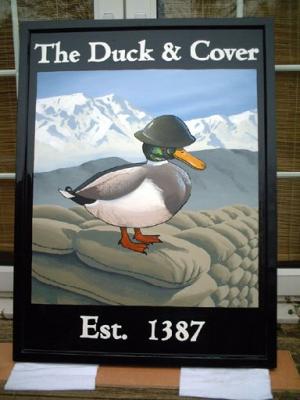
The USAID guy peeled off for a welcome dinner with other AID types, and I ate with the guy in charge of my in-processing -- surprisingly tasty chicken teriyaki, steamed vegetables, a pineapple juice box. I swung by the Marine guard to get my Embassy badge (different than a State badge, applicable only to Embassy Kabul) and then walked to the Embassy bar -- the Duck and Cover -- to meet a friend from training for a beer.


The executive summary is that Embassy Kabul looks good to very good. The main chancery is even architecturally sound (I'd include a picture but photography is strictly verboten), which isn't bad given that we're in a war zone. Compound life appeals to me: it's like college, where everyone's around all the time and there's always something going on if you know where you look. Only unlike college, there's a significantly larger amount of danger pay and I don't have to wait tables.

And all of that is good news, because I just accepted a handshake on a second year in Afghanistan, transferring from my post in the field to a position in the Public Affairs section in Kabul. I'm guessing that after a year in the middle of nowhere, surrounded by a thousand soldiers and an incredible amount of dust, a swimming pool and a couple hundred like-minded civilians will do me good.